Home/Templates/Legal/Nonprofit Formation Checklist: State Registration Requirements

Nonprofit Formation Checklist: State Registration Requirements

Nonprofit Formation and State Compliance Resource

Streamline nonprofit formation with our state registration and formation checklist. For attorneys, nonprofit founders, and formation services establishing 501(c)(3) or other tax-exempt organizations. Cover name availability and reservation, articles of incorporation filing, registered agent, bylaws adoption, EIN, state charitable registration (where required), and ongoing compliance so you form correctly in your state and prepare for IRS tax-exempt status. State requirements vary; use this checklist as your roadmap and confirm with your state and advisor.
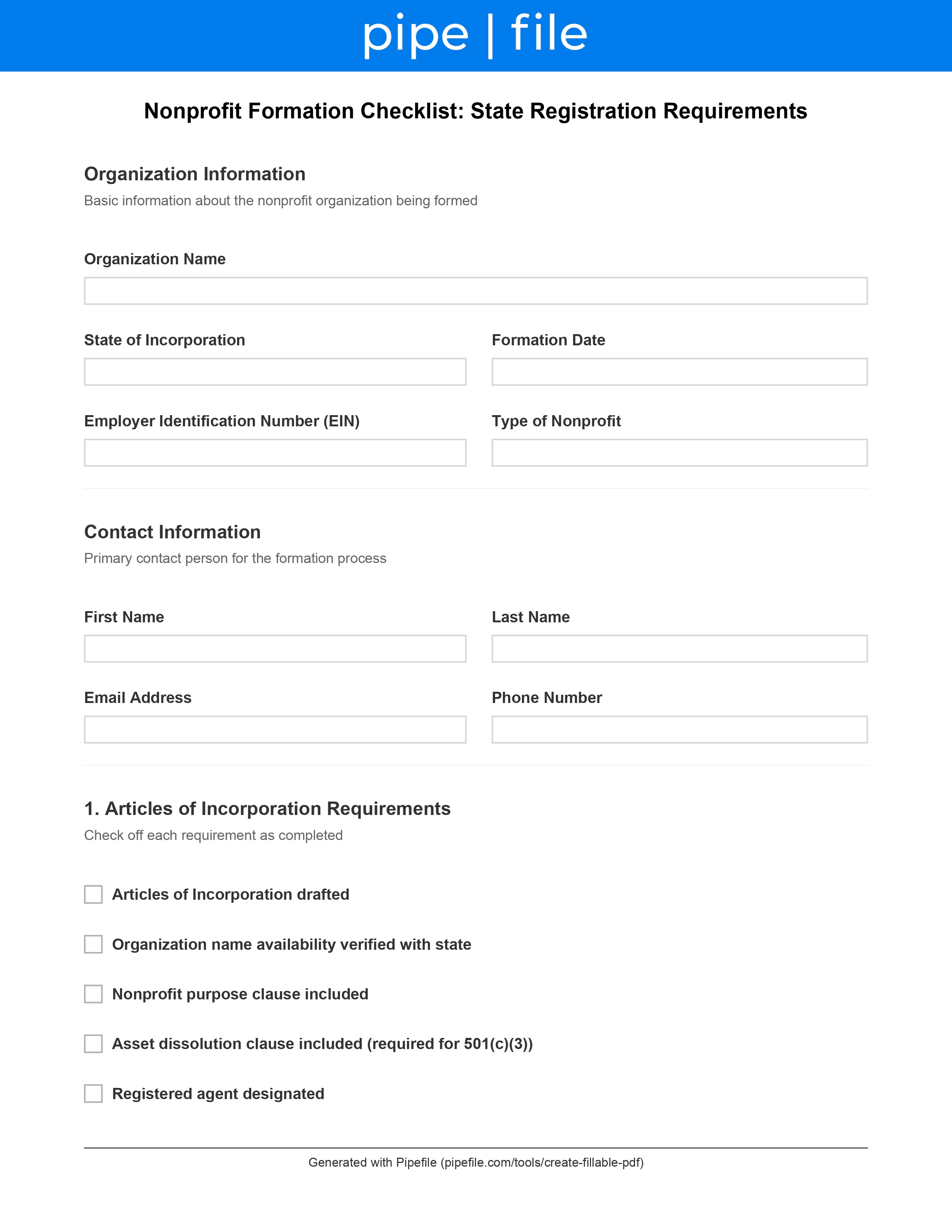
Nonprofit Formation Checklist: State Registration Requirements form template preview

Key Benefits

Complete state formation steps in order
Meet name, articles, and registered agent requirements
Prepare for EIN and IRS tax-exempt application
Identify state charitable registration obligations
Track ongoing compliance (annual reports, renewals)
Professional nonprofit formation workflow

Common Use Cases

Attorneys forming new 501(c)(3) or other nonprofitsNonprofit founders self-forming and staying compliantFormation services guiding clients through state stepsChurches, charities, and educational organizationsOut-of-state nonprofits registering to solicit or operateBoards and staff maintaining formation and registration records

Frequently Asked Questions

In what order should I complete nonprofit formation steps?
Typically: (1) choose and verify/reserve name, (2) draft and file articles of incorporation with the state, (3) appoint registered agent, (4) hold organizational meeting and adopt bylaws, (5) obtain EIN from IRS, (6) open bank account, (7) apply for federal tax-exempt status (Form 1023/1023-EZ) if desired, (8) register with state charity office if required for your state or if you will solicit in other states.
Do I need to register my nonprofit in every state where I operate or fundraise?
Most states require nonprofits that solicit donations (or sometimes operate) in that state to register with the state charity office and file annual reports. Forming in one state (your 'home' state) is enough to create the entity; separate registration is required where you solicit or do business. Check each state's rules and exemptions (e.g. churches, small thresholds).
What is a registered agent and why is it required?
A registered agent is a person or entity in the state of incorporation with a physical address who accepts legal and official documents (e.g. service of process, state notices) on behalf of the corporation. States require a registered agent to be named in the articles and maintained so the state and courts have a reliable contact. The agent must be available during business hours.
When do I need to file state charitable registration?
Many states require registration before or soon after you begin soliciting contributions in that state. Some require registration even if you only operate there. Exemptions may apply (e.g. religious organizations, very small amounts). Check your state's charity office and any state where you plan to solicit; deadlines and forms vary.

Checklist

Pre-Formation

Choose corporate name and check availability with state (and reserve if desired)
Required

Name must comply with state nonprofit naming rules (often must indicate nonprofit/Inc.). Search secretary of state database; reserve name if state allows and you are not filing immediately.

State Filing

Draft and file articles of incorporation with secretary of state (or equivalent)
Required

Include name, purpose, registered agent, registered office, incorporators, dissolution clause, no-stock provision. Pay filing fee. Obtain certified copy for records and EIN application.

State Compliance

Appoint and maintain registered agent in state of incorporation
Required

Must have physical address in state; accept service of process and state notices. Update state if agent or address changes. Many states require annual or periodic confirmation.

Register with state charity office (in state of formation and where you solicit)
Required

Many states require registration before soliciting; some require it for any in-state operation. Check exemptions (religious, small amounts). File initial form and annual reports where required.

Register to solicit in other states where you will fundraise
Required

If you solicit donations in states other than your state of formation, register in those states (or qualify for exemption). Multistate registration can be complex; consider counsel or a compliance service.

Governance

Hold organizational meeting; adopt bylaws and appoint initial directors/officers
Required

Incorporators or initial board adopt bylaws, elect directors and officers, authorize EIN application and bank account. Keep minutes and signed bylaws in corporate records.

Federal

Obtain Employer Identification Number (EIN) from IRS
Required

Apply online, by fax, or mail. Free. Need certified articles and responsible party info. EIN required for bank account and Form 1023.

Apply for federal tax-exempt status (Form 1023 or 1023-EZ) if seeking 501(c)(3)

File within 27 months of formation to get determination retroactive to formation. 1023-EZ if eligible (smaller orgs). Churches may be exempt from filing. Fee applies.

Operations

Open nonprofit bank account (use EIN and board resolution)
Required

Bank will require EIN, articles, bylaws, and board resolution authorizing account and signers. Keeps funds separate and supports transparency.

Ongoing Compliance

File state annual reports and maintain good standing
Required

Most states require annual (or periodic) reports and fees for corporations. Charity registration states often require separate annual filings. Calendar due dates to avoid penalties and loss of good standing.

Maintain corporate records (articles, bylaws, minutes, resolutions, registrations)
Required

Keep a records book or secure digital copies. Required for governance, IRS, and state audits. Include EIN letter, charity registration confirmations, and annual report receipts.