Home/Templates/Legal/Nonprofit Articles of Incorporation Template

Nonprofit Articles of Incorporation Template

Nonprofit Formation and Legal Resource

Streamline nonprofit formation with our articles of incorporation checklist and template guide. For attorneys, nonprofit founders, and formation services establishing 501(c)(3) or other tax-exempt organizations. Ensure your articles include corporate name, charitable purpose, registered agent and office, incorporators, dissolution clause (assets to another nonprofit), and state-required provisions so you meet state filing requirements and lay the groundwork for IRS tax-exempt status. Covers key provisions for nonprofit corporations in the US.
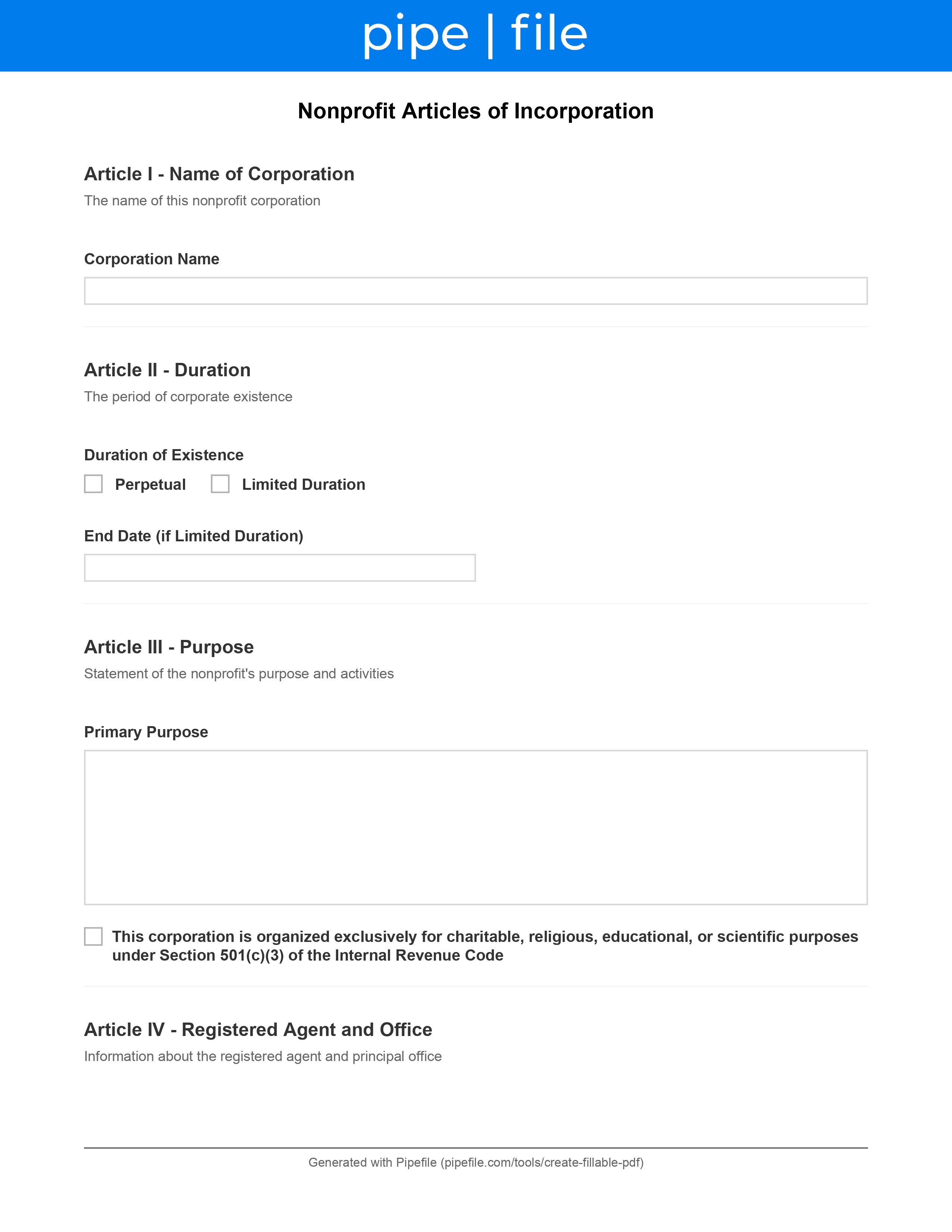
Nonprofit Articles of Incorporation Template form template preview

Key Benefits

Include all state-required provisions for nonprofit corporations
Draft charitable purpose and dissolution language for 501(c)(3)
Identify registered agent, office, and incorporators
Support IRS Form 1023/1023-EZ application readiness
Avoid amendments by getting articles right at formation
Professional nonprofit formation workflow

Common Use Cases

Attorneys forming 501(c)(3) or other tax-exempt organizationsNonprofit founders self-filing with state and preparing for IRSFormation services and registered agents preparing nonprofit filingsChurches, charities, and educational organizations incorporatingExisting nonprofits amending articles or reincorporatingLegal and compliance review of draft articles

Frequently Asked Questions

What is the difference between nonprofit articles of incorporation and for-profit articles?
Nonprofit articles typically state a charitable, educational, religious, or other exempt purpose; include a dissolution clause requiring assets to go to another 501(c)(3) or similar organization; and do not authorize stock. State law may require specific language for tax-exempt eligibility. For-profit articles authorize stock and do not include these restrictions.
Why is the dissolution clause important in nonprofit articles?
The IRS and many states expect nonprofit articles to provide that upon dissolution, assets will be distributed to another tax-exempt organization or for charitable purposes. This ensures assets remain dedicated to the exempt purpose and supports 501(c)(3) approval. Language should match your state statute and IRS expectations.
Do I need an attorney to file nonprofit articles?
Many states allow founders to file articles without an attorney, but state requirements vary and errors can delay or complicate IRS tax-exempt application. An attorney or formation service can ensure purpose language, dissolution clause, and other provisions meet both state and IRS requirements.
When should I file articles of incorporation for my nonprofit?
File with the state first; the corporation exists once the state approves the filing. Apply for an EIN and then for federal tax-exempt status (Form 1023 or 1023-EZ) after formation. Having articles that include appropriate purpose and dissolution language from the start simplifies the IRS application.

Checklist

Identity

Corporate name (must comply with state nonprofit naming rules; often must indicate nonprofit or similar)
Required

Check state availability and reserved words. Some states require 'Inc.', 'Corporation', or similar. Avoid names that imply endorsement or confuse with existing entities.

Purpose

Statement of purpose (charitable, educational, religious, scientific, or other exempt purpose per IRC § 501(c)(3) or other subsection)
Required

Language should align with IRS requirements for the exemption you seek. Broad charitable/educational purpose is common; some states require specific wording. Attorney can tailor for your mission and state.

Dissolution clause (assets to another 501(c)(3) or charitable purpose upon dissolution)
Required

Required by IRS for 501(c)(3). Upon dissolution, net assets go to another tax-exempt organization or for exempt purposes. State may have model language.

Formation

Registered agent name and address (in state of incorporation)
Required

Agent must have a physical address in the state and accept service of process. Can be an individual or qualified entity.

Registered office address (often same as registered agent)
Required

Must be a physical address in the state. Some states allow the principal office to be elsewhere.

Name(s) and address(es) of incorporator(s)
Required

Incorporators sign and file the articles (or adopt initial bylaws). State may require one or more. Need not be directors or officers.

Initial director(s) (if required by state)

Some states require initial directors in the articles; others allow the incorporators to name them in a separate action. Check state law.

Duration (usually perpetual unless state requires otherwise)

Most articles state that the corporation has perpetual duration. Some states default to perpetual if not specified.

Structure

Statement that the corporation does not have stock or is non-stock
Required

Nonprofit corporations typically do not authorize stock. State form or statute may prescribe exact language.

Governance

Conflict-of-interest or private inurement prohibition (if required by state)

Some states require a clause that no director or officer may benefit improperly. Helps support 501(c)(3) compliance and good governance.

Amendment provision (how articles may be amended, per state law)

State law often governs; articles may restate or specify vote required (e.g. board and/or members). Include if your state permits or requires it.

Filing

Signature(s) of incorporator(s) and filing with state (with fee)
Required

File with the secretary of state or equivalent. Pay filing fee. Obtain certified copy for EIN and IRS application. Some states offer expedited processing.