Home/Templates/Legal/Grant Readiness Checklist: Foundation Funding Prep

Grant Readiness Checklist: Foundation Funding Prep

Nonprofit Grants and Fundraising Resource

Get your nonprofit grant-ready with our foundation funding prep checklist. For 501(c)(3) organizations, development staff, and boards preparing to pursue foundation and institutional grants. Ensure tax-exempt status and good standing, governance policies and board composition, current financials and organizational budget, case for support and capacity narrative, state registrations where you solicit, and systems for reporting so you can respond quickly to opportunities and present a strong, credible application. Use this checklist before you write proposals—readiness reduces last-minute gaps and strengthens your success rate.
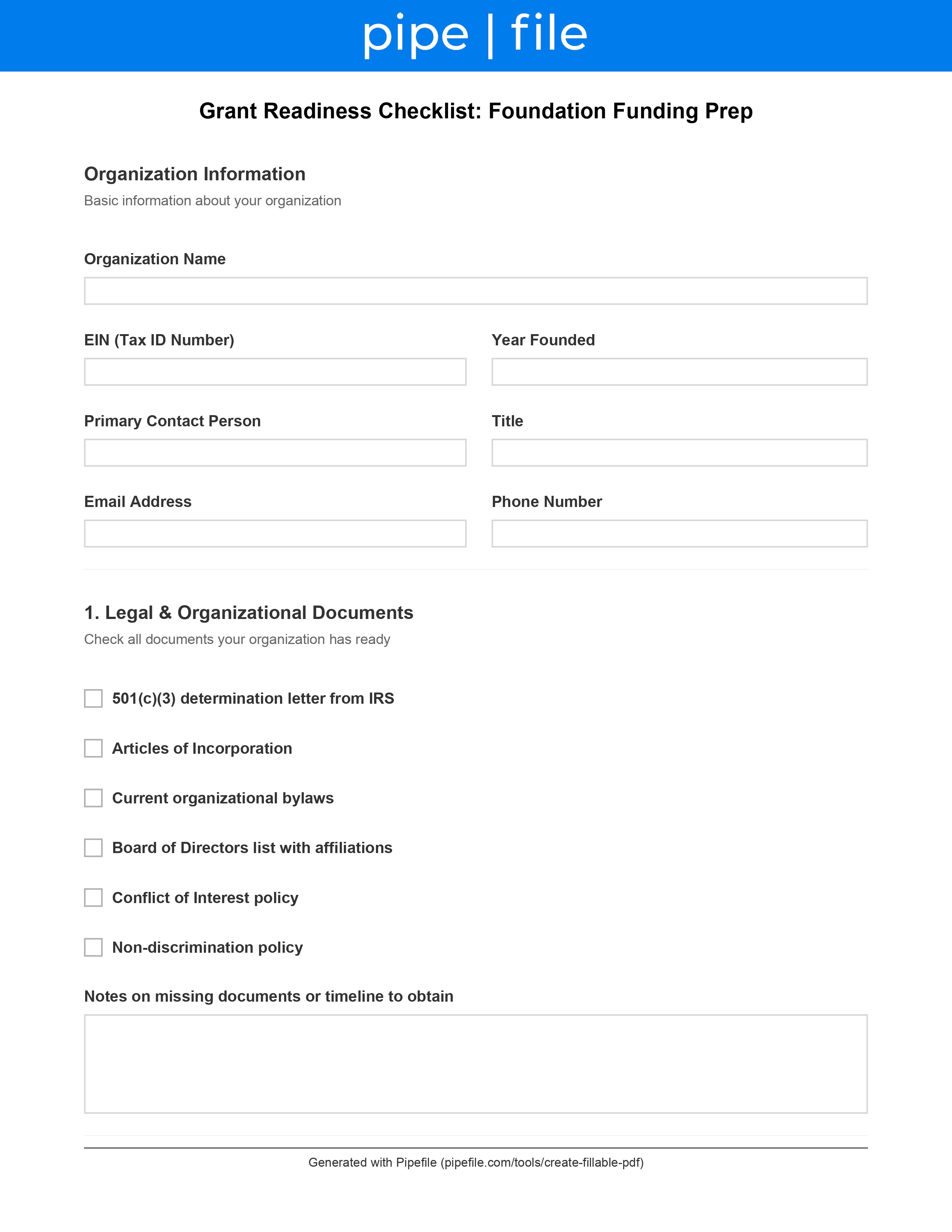
Grant Readiness Checklist: Foundation Funding Prep form template preview

Key Benefits

Assess and close gaps before applying for grants
Gather documents and policies funders commonly require
Strengthen governance and financial presentation
Build a reusable grant-ready toolkit
Respond faster to LOIs and RFPs
Professional grant development workflow

Common Use Cases

501(c)(3) organizations preparing for first or expanded grant applicationsDevelopment staff auditing readiness for foundation and institutional fundersBoards and EDs ensuring governance and compliance support fundraisingNonprofits building capacity before a major grant campaignOrganizations registering in new states for multi-state fundraisingGrant writers verifying attachments and policies are current

Frequently Asked Questions

What does grant ready mean?
Grant ready means your organization has in place the legal status, governance, financial documents, and narrative capacity that funders typically require before or with an application. You can produce a determination letter, board list, financials, and a clear description of your work without scrambling. Readiness lets you respond to opportunities on deadline and present a professional, credible package.
Do we need an audit to be grant ready?
Not always. Many foundations accept unaudited financials and Form 990. Larger grants (e.g. six figures or multi-year) often require an audit or reviewed financials. Government grants frequently require audits above a spending threshold. Check target funders' guidelines; if you plan to pursue larger institutional or government grants, plan for an audit when your size warrants it.
What governance items do funders look for?
Funders often ask about or expect: a conflict of interest policy, an active and engaged board, clear roles (no excessive insider compensation), and sometimes a whistleblower or document retention policy. Form 990 Part VI and governance questions on applications reflect these expectations. Having policies in place and current board lists and minutes supports credibility.
When should we do a grant readiness review?
Ideally before you launch a grant strategy or at least before your first major applications. Review annually or when you add new funder types (e.g. first government grant, first large foundation). Use this checklist to fix gaps (e.g. update policies, get state registrations) so that when an RFP drops, you're ready to write rather than to gather missing documents.

Checklist

Legal & Compliance

501(c)(3) or equivalent tax-exempt status in good standing (current IRS determination letter)
Required

Most foundations only fund 501(c)(3) organizations. Have a current, legible copy of your determination letter. Confirm you have not had exempt status revoked (e.g. for missing Form 990).

Form 990 (or 990-EZ / 990-N) filed and up to date for required years
Required

Funders often request the most recent 990. Late or missing filings can disqualify you or raise red flags. Use the annual compliance checklist to stay current.

State charitable registration current in states where you solicit or operate (if required)
Required

Many states require registration before soliciting. Funders may require good standing. Track renewal dates and file on time where you fundraise.

Governance

Conflict of interest policy adopted and on file
Required

Commonly expected by foundations and reflected on Form 990. Adopt and document; collect annual disclosures from board and key staff.

Current board of directors list (and brief bios if needed for applications)
Required

Keep an up-to-date list with names, titles, and optional short bios. Update when board changes; many applications ask for board diversity or composition.

Financial

Current organizational (operating) budget and prior year financial statements
Required

Funders want to see overall financial health and how a grant fits. Have current fiscal year budget and prior year actuals or 990 available.

Audit or reviewed financials (if required by target funders or grant size)

Not all funders require an audit. Larger grants and government often do. If you're targeting those, plan for audit or review when your size and funder criteria warrant it.

Narrative & Capacity

Case for support or capacity narrative (mission, programs, impact, why you)
Required

A concise, reusable description of your organization, programs, and impact. Proposals pull from this; having it drafted speeds application writing and keeps messaging consistent.

Program goals and outcomes (measurable where possible) for key activities
Required

Funders want to know what will change. Document goals and outcome metrics for main programs so you can plug them into proposals and evaluation sections.

Capacity

Systems to track and report on grant deliverables (budget, outcomes, deadlines)

Once you win grants, you'll need to report. Simple tracking for budget vs. actual and outcome data helps you meet reporting requirements and reapply with evidence of impact.

Submission Prep

Easy-to-access copies of IRS determination letter and key attachments for proposals
Required

Keep digital copies ready (PDF). Many applications ask for the same attachments; a grant toolkit folder speeds assembly for each application.