Home/Templates/Legal/Form 990 Checklist: Annual Return Filing Requirements

Form 990 Checklist: Annual Return Filing Requirements

Nonprofit IRS Compliance and Finance Resource

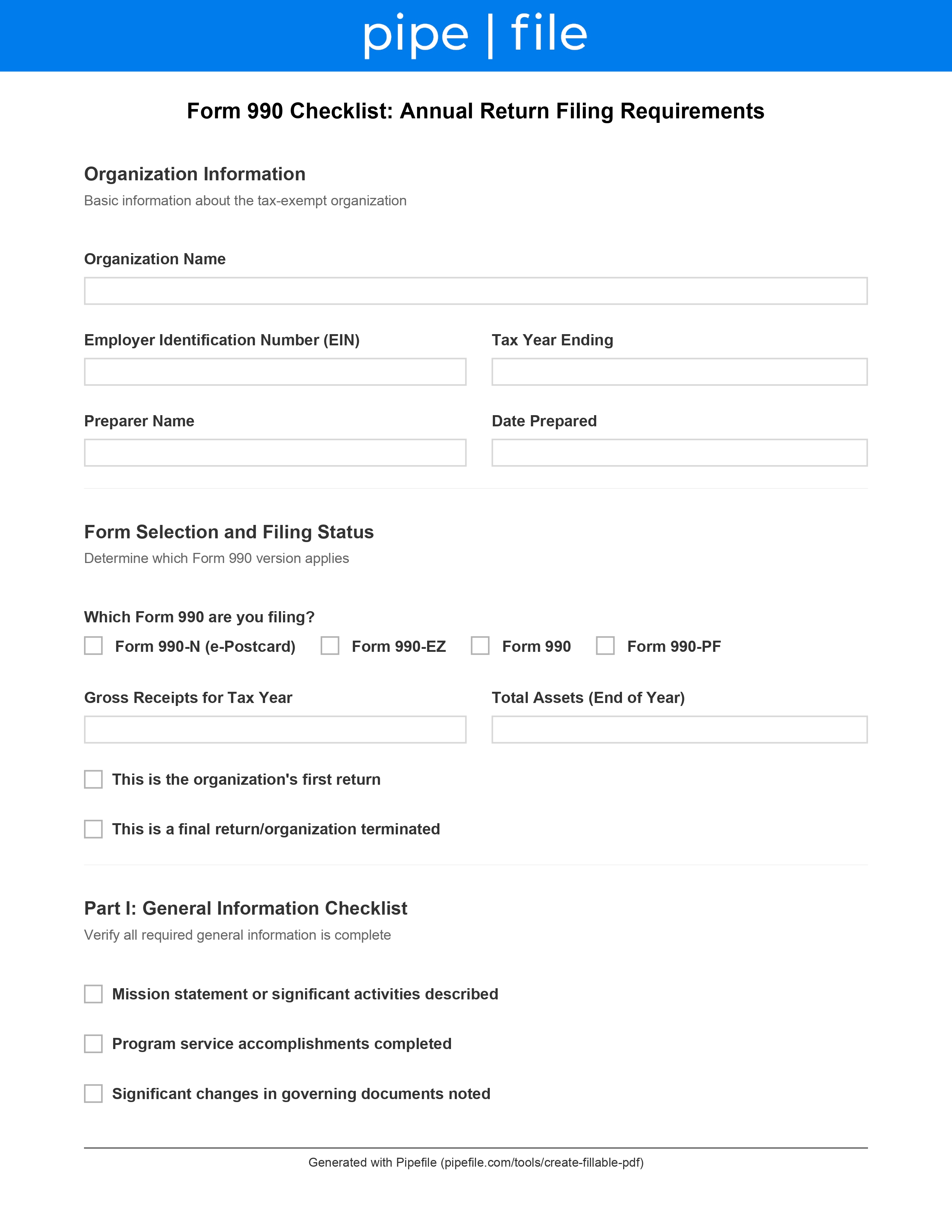
Streamline your nonprofit's Form 990 filing with our annual return checklist. For 501(c)(3) and other tax-exempt organizations, finance staff, and preparers. Form 990 (or 990-EZ or 990-N) is the IRS annual information return. Determine which form to file based on gross receipts and assets, gather financial data and governance information, complete identification and revenue/expense sections, answer governance and compensation questions (Part VI, VII), complete required schedules (e.g. Schedule A for public support), and e-file by the deadline so you stay in compliance and avoid penalties or revocation of exempt status. Use this checklist each year to prepare a complete, accurate return.
Key Benefits

Determine correct form (990, 990-EZ, or 990-N) by size and type
Gather financial and governance data in one place
Complete identification, revenue, expenses, and balance sheet
Address governance and compensation questions accurately
File on time and avoid revocation risk
Professional nonprofit compliance workflow

Common Use Cases

501(c)(3) organizations filing their annual information returnNonprofit CFOs, bookkeepers, and CPAs preparing Form 990Boards and staff ensuring governance answers are supportableSmall organizations filing 990-N (e-postcard) or 990-EZLarger organizations completing full 990 and schedulesFirst-time filers learning Form 990 requirements

Frequently Asked Questions

When is Form 990 due?
Form 990 (or 990-EZ or 990-N) is due by the 15th day of the 5th month after the end of your fiscal year. For calendar-year organizations, that's May 15. You can request an automatic 6-month extension (Form 8868). Filing late can result in penalties; failing to file for three consecutive years can result in automatic revocation of your tax-exempt status.
Which form do I file—990, 990-EZ, or 990-N?
990-N (e-postcard): gross receipts normally $50,000 or less. 990-EZ: gross receipts less than $200,000 and total assets less than $500,000. Full Form 990: gross receipts $200,000 or more, or total assets $500,000 or more. Certain organizations (e.g. private foundations) must file specific forms. Check the IRS Form 990 instructions for the current year; thresholds and rules can change.
What if we miss the Form 990 deadline?
File as soon as possible. Request an extension (Form 8868) before the due date if you need more time. Penalties apply for late filing; amount depends on organization size and how late. If you've missed three years and received a revocation letter, you may need to reapply for exemption (Form 1023) and possibly pay a fee. Don't ignore missed filings—file and pay any penalties to restore good standing.
Is Form 990 public?
Yes. Form 990 is a public document. The IRS makes exempt organization returns available; many nonprofits also post their 990 on their website or provide it to donors and grantmakers. Ensure all information is accurate and that governance and compensation disclosures are consistent with your policies and board records.

Checklist

Preparation

Determine which form to file: 990-N, 990-EZ, or full 990 (by gross receipts and total assets)
Required

990-N: gross receipts ≤$50K. 990-EZ: receipts <$200K and assets <$500K (check current year instructions). Full 990: receipts ≥$200K or assets ≥$500K. Private foundations use 990-PF. Confirm thresholds in IRS instructions for your tax year.

Deadline

Note due date (5th month after fiscal year end) and file extension (Form 8868) if needed
Required

Due date is 15th day of 5th month (e.g. May 15 for calendar year). Automatic 6-month extension available; file Form 8868 by due date. E-file required for most 990/990-EZ filers.

Form 990 Parts

Complete Part I (identification): name, EIN, address, fiscal year, website, mission)
Required

Basic org info. Ensure legal name and EIN match IRS records. Mission statement often pulled from organizing document or website.

Complete revenue and expense sections (Parts VIII, IX) from books and financial statements
Required

Report income by category (contributions, program revenue, investment income, etc.) and expenses (program, management, fundraising). Use accrual or cash per instructions; match to audited or internal financials.

Complete balance sheet (Part X) if filing 990 or 990-EZ
Required

Assets, liabilities, net assets. 990-N does not require balance sheet. Ensure consistency with financial statements.

Complete program service accomplishments (Part III) — describe mission and program achievements
Required

Narrative and/or statistics describing what the organization did during the year. Required for 990 and 990-EZ; be specific and accurate. Grantmakers and donors often review this.

Governance

Complete Part VI (governance, policies, disclosure): board, conflict policy, Form 990 review
Required

Questions on board composition, independence, conflict of interest policy, Form 990 review process, and other policies. Answer yes/no and provide explanations where required. Have board minutes and policies on hand.

Complete Part VII (compensation): officers, directors, key employees, highest-paid staff)
Required

List compensated individuals and amounts. Report base compensation, bonus, and other compensation. Schedule O may be needed for additional detail. Ensure consistency with payroll and board records.

Schedules

Complete Schedule A (public support) if required for public charity status

Most 501(c)(3) public charities complete Schedule A to show public support test (509(a)(1) or 509(a)(2)). Required when form instructions say so. Supports continued public charity classification.

Complete other required schedules (B, D, G, O, etc.) per form instructions

Schedule B (contributors), D (conservation, etc.), G (fundraising), O (supplemental information), and others may apply depending on activities and size. Check the form line items and instructions.

Submission

E-file the return (required for most 990/990-EZ filers; 990-N via IRS portal)
Required

IRS requires electronic filing for 990 and 990-EZ (with limited exceptions). Use IRS-approved software or a tax professional. 990-N is filed through the IRS 990-N e-postcard system. Keep acknowledgment or confirmation.

Keep a copy of the filed return and IRS acknowledgment for records
Required

Retain for at least 7 years. Required for audits and often requested by grantmakers. Public so ensure copy is available for board and stakeholders.