Home/Templates/Legal/Estate Planning/Trust Funding Checklist: Asset Transfer Guide

Trust Funding Checklist: Asset Transfer Guide

Estate Planning and Trust Administration Resource

Complete your trust with our trust funding checklist and asset transfer guide. For grantors, trustees, and estate planning attorneys. Creating a trust is only the first step—assets must be transferred (funded) into the trust for it to control them and avoid probate. Use this checklist to retitle real estate, bank and investment accounts, and other assets into the trust's name; update beneficiary designations where appropriate (e.g. life insurance, retirement); and avoid common mistakes like wrong trust names or forgetting assets. State and institution rules vary; work with your attorney and financial institutions to fund the trust correctly.
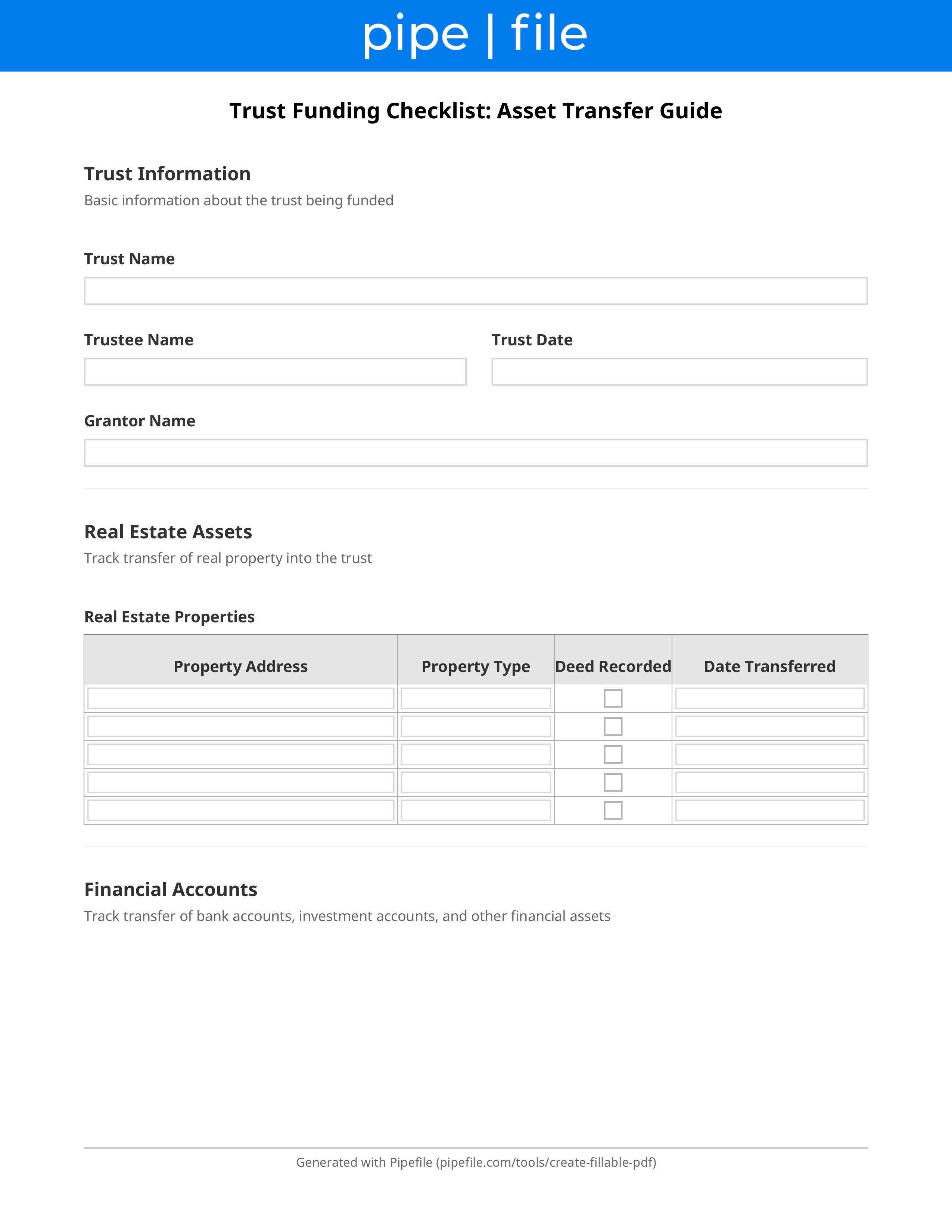
Trust Funding Checklist: Asset Transfer Guide form template preview

Key Benefits

Transfer assets into the trust so it controls them
Retitle real estate, accounts, and investments correctly
Update beneficiary designations (life insurance, retirement) as planned
Avoid common funding mistakes and probate for unfunded assets
Keep an inventory and coordinate with your attorney
Professional trust funding workflow

Common Use Cases

Grantors who just created a revocable living trust and need to fund itEstate planning attorneys guiding clients through the funding processTrustees taking over and ensuring all intended assets are in the trustFamilies updating trust funding after a move, new account, or new propertyEstate planners coordinating with title companies and financial institutionsAnyone with a pour-over will ensuring the trust is the primary holder of assets

Frequently Asked Questions

What is trust funding?
Trust funding is the process of transferring ownership of assets into the name of your trust so the trust actually holds and controls them. Until an asset is retitled or assigned to the trust, it is not 'in' the trust—even if the trust document exists. Unfunded assets may pass by will (and go through probate) or by beneficiary designation, which can defeat the purpose of having a trust.
What happens if I don't fund my trust?
Assets that are never transferred into the trust generally do not avoid probate. They may pass under your will (e.g. via a pour-over will into the trust, but probate is still required to get them there) or by operation of law (joint ownership, beneficiary designation). Funding the trust during life is what allows those assets to avoid probate and be administered under the trust terms.
Should I put retirement accounts (IRA, 401(k)) in my trust?
Usually not. Transferring an IRA or 401(k) into a trust during life can trigger taxes and penalties. Instead, name the trust as beneficiary of the retirement account if your estate plan calls for it (e.g. for minor or spendthrift protection). Naming individuals as beneficiaries has different tax implications. Your attorney or CPA can advise on the best beneficiary designation for your situation.
Can I fund the trust after I die?
A pour-over will can direct that assets still in your name at death 'pour over' into the trust, but those assets typically must go through probate first. To avoid probate for those assets, they need to be funded during life. Some assets (e.g. payable-on-death accounts) can name the trust as beneficiary so they pass to the trust at death without probate—confirm with your attorney which approach to use for each asset type.

Checklist

Planning

List all assets to be funded: real estate, accounts, investments, insurance, business interests
Required

Create a complete inventory. For each asset, note current title/ownership and whether it will be retitled to the trust, or whether the trust will be named beneficiary. Some assets (e.g. retirement) are typically not retitled; beneficiary designation is used instead.

Use the exact legal name of the trust (as in the trust agreement) on all transfers
Required

Incorrect names (e.g. typo, old amendment) can cause rejections or require corrective deeds/forms. Use the full name, e.g. 'John Doe, Trustee of the John Doe Revocable Trust dated [date].'

Real Estate

Execute and record deed(s) transferring real estate into the trust
Required

Prepare a new deed (grant deed, quitclaim, or other per state custom) from current owner to the trust. Record with the county recorder. Check for mortgage consent or due-on-sale issues (consult lender/attorney).

Financial Accounts

Retitle bank accounts (checking, savings, CDs) into the trust
Required

Contact each bank; they will require a copy of the trust (or certification) and new signature cards. Retitle in the trust's name. Update any linked accounts or auto-pay.

Transfer brokerage and investment accounts into the trust
Required

In-kind transfer to the trust to avoid selling and tax. Broker will need trust document and transfer forms. Confirm registration and titling with the institution.

Beneficiary Designations

Review and update beneficiary designations on IRAs, 401(k)s, and other retirement accounts
Required

Do not retitle retirement accounts into the trust during life (tax consequences). Name the trust as beneficiary only if your plan requires it; otherwise name individuals. Get tax/estate advice; designations override the will.

Name the trust as beneficiary of life insurance (if part of your plan)

If the trust is to own or receive policy proceeds (e.g. for minor beneficiaries or creditor protection), update the policy beneficiary to the trust. Confirm with your attorney; sometimes the trust is owner and beneficiary.

Business

Transfer business interests (LLC membership, partnership, shares) into the trust per operating agreement or bylaws

Assign membership interest or shares to the trust. Check operating agreement or bylaws for transfer restrictions and consent. Update cap table or company records.

Other Assets

Assign or transfer tangible personal property to the trust (if desired)

A general assignment of personal property can transfer items without formal title (e.g. furniture, jewelry). For vehicles, boats, or titled property, complete state transfer procedures to the trust.

Ongoing

Verify no assets were missed; recheck new accounts or property acquired after funding
Required

New accounts or property should be titled in the trust (or beneficiary set) as they are acquired. Periodically review with your attorney to keep the trust fully funded.