←Home/Templates/Finance/Lending/Self-Employed Mortgage Checklist: Document Requirements

Self-Employed Mortgage Checklist: Document Requirements

Self-Employed Borrower and Mortgage Resource

Streamline your self-employed mortgage application with our comprehensive document checklist. For sole proprietors, partners, and S-corp or C-corp owners using tax returns to qualify, plus loan officers. Gather two years of personal and business returns with all schedules, YTD P&L, K-1s, a 4506-C, business license or entity docs, and assets so underwriting can calculate qualifying income correctly.
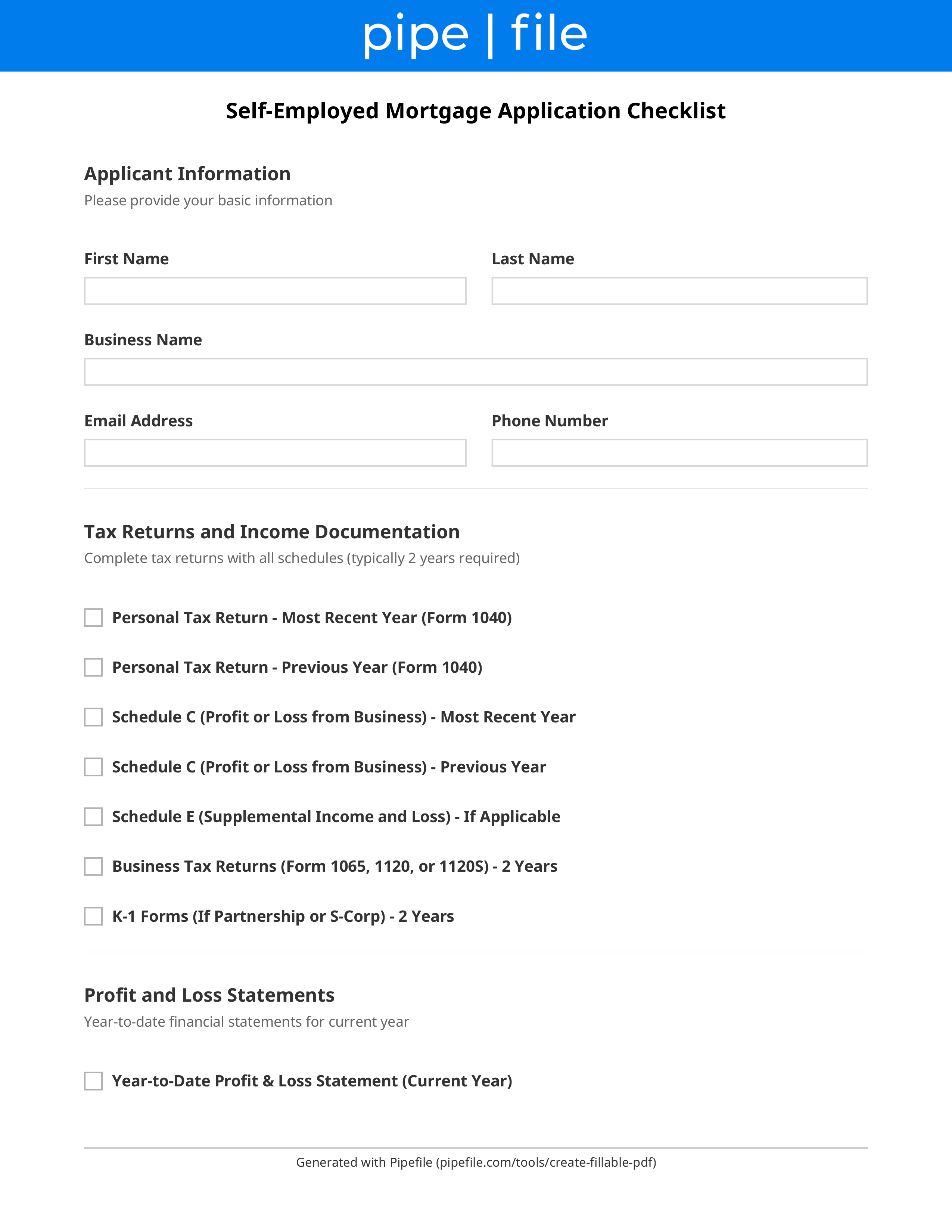
Self-Employed Mortgage Checklist: Document Requirements form template preview

Key Benefits

Collect complete personal and business tax-return packages
Include K-1s, YTD P&L, and balance sheet when required
Prepare 4506-C so transcripts do not delay the file
Document the business exists and you have a two-year history
Reduce conditions on Schedule C, 1065, and 1120-S income
Professional self-employed mortgage workflow

Common Use Cases

Sole proprietors qualifying on Schedule CLLC and S-corp owners using K-1 and W-2 incomeLoan officers calculating self-employed incomeBorrowers choosing tax-return QM vs. bank-statement Non-QMUnderwriters requesting a YTD P&L mid-yearCPAs assembling a mortgage tax package for clients

Frequently Asked Questions

How do lenders calculate self-employed income?
Underwriters average the last two years of qualifying income from tax returns, adding back allowed depreciation and certain non-cash items, and may use the lower of the average or the most recent year if income is declining. K-1 cash distributions and business liquidity also matter for partnerships and S-corps.
What tax documents do I need?
Typically two years of personal 1040s with all schedules, two years of business returns (1120, 1120-S, or 1065), K-1s, and a signed 4506-C. If more than 120 days into the year, many programs also want a YTD P&L (and sometimes a balance sheet) covering the business.
What if my returns show low income because of write-offs?
QM tax-return programs must use the tax returns. If write-offs crush qualifying income, consider a bank-statement or P&L Non-QM program instead. Do not omit schedules; 4506-C transcripts will show them.
Do I need two years in business?
Most QM programs want two years of self-employment in the same line of work. A shorter history can work with a strong prior W-2 in the same field and compensating factors, or with a Non-QM overlay. Document the history on the application and with licenses or contracts.

Checklist

Application

Complete 1003 listing all businesses and ownership percentages
Required

Two-year work history. Disclose every entity you own 25%+.

Income Documentation

Personal federal tax returns (2 years, all schedules)
Required

Include Schedule C, E, F, and K-1s. All pages. Signed if the lender requires.

Business federal tax returns (2 years) for each entity 25%+
Required

1120, 1120-S, or 1065 with all schedules. Matches K-1s on the 1040.

Year-to-date P&L (and balance sheet if required) signed by the borrower

Usually required if the fiscal year is more than 120 days in. Must be consistent with returns.

Signed IRS Form 4506-C for personal and business transcripts
Required

Lender orders transcripts. Mismatches with filed returns cause delays.

Business Documentation

Business license, entity docs, or CPA letter confirming the business
Required

Shows the business exists and you have history in the same line of work.

Asset Documentation

Asset statements for down payment and reserves (all pages)
Required

Large deposits from the business need a paper trail.

Identity

Government-issued photo ID for all borrowers
Required

Driver's license or passport. Credit authorization included.