Home/Templates/General/Scope of Work Template

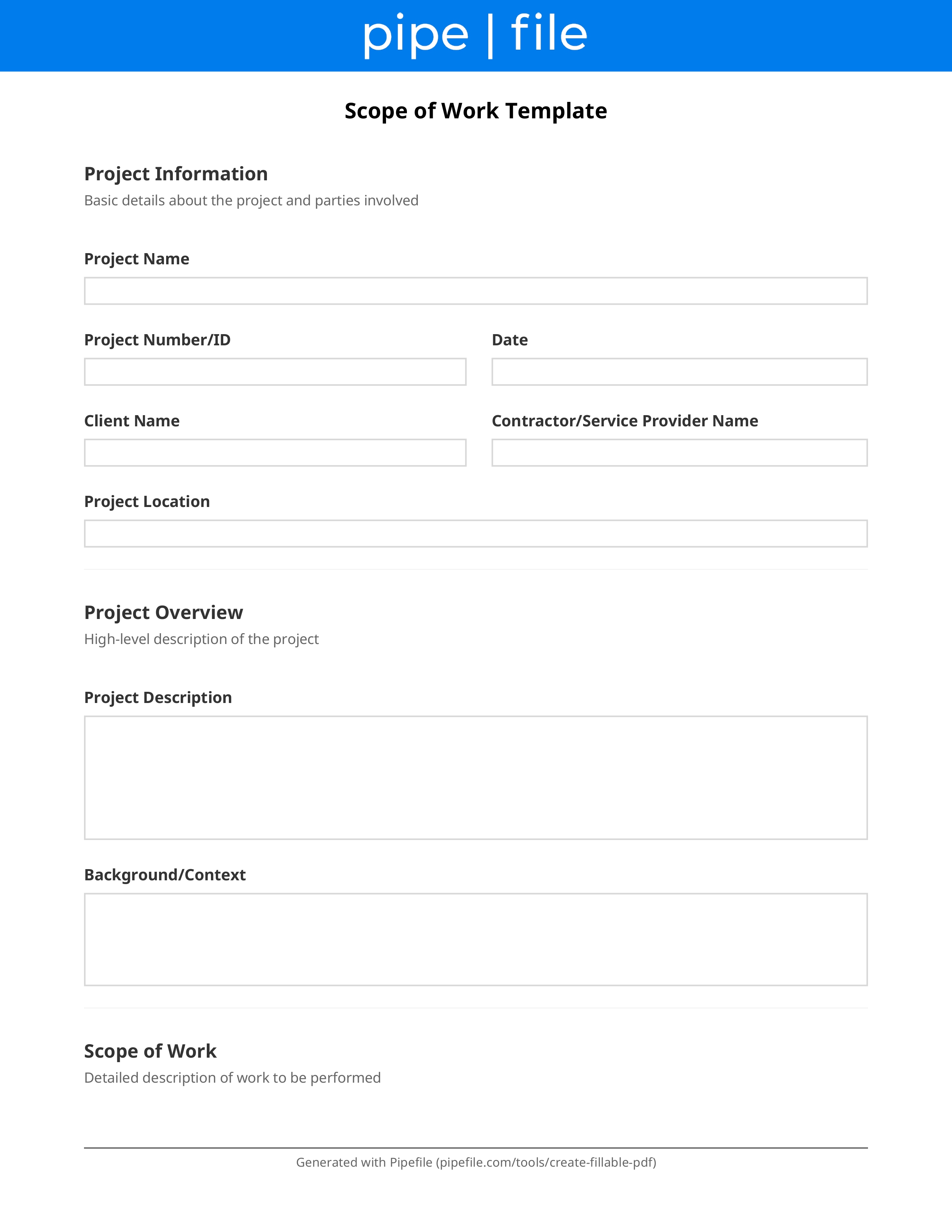
Scope of Work Template

Consultants, Agencies, and Project Management Resource

Define project scope clearly with our scope of work (SOW) template and checklist. For consultants, agencies, contractors, and clients. A scope of work sets out the project or engagement name, parties, objectives, in-scope deliverables and tasks, out-of-scope items and assumptions, timeline and milestones, acceptance criteria, and (if applicable) fees or a reference to the master agreement. Use this checklist to draft or review SOWs so both sides agree on what will be done, when, and how it will be accepted—reducing scope creep and disputes. Often used alongside a consulting or service agreement.
Key Benefits

Spell out deliverables and tasks in one place
Set timeline, milestones, and acceptance criteria
Clarify what is out of scope and key assumptions
Reduce scope creep and rework
Support change orders when scope changes
Professional project and contract workflow

Common Use Cases

Consultants and clients defining a specific project under a master agreementAgencies and clients documenting campaign or project scopeIT and software projects (implementation, integration, custom development)Construction and professional services (architecture, engineering)Freelancers and clients agreeing on deliverables before startingInternal projects documenting scope for stakeholders

Frequently Asked Questions

What is a scope of work (SOW)?
A scope of work (or statement of work) is a document that describes the specific work to be performed for a project or engagement. It typically includes objectives, deliverables, tasks, timeline, milestones, and acceptance criteria. It can be a standalone document or an attachment to a master consulting or service agreement. It helps both parties agree on what is (and is not) included.
What is the difference between a SOW and a contract?
A contract (e.g. consulting agreement) sets the legal and commercial terms: parties, fees, payment, confidentiality, IP, termination. A SOW focuses on the work itself: what will be delivered, when, and how it will be accepted. Often you have both: a master agreement plus one or more SOWs for each project or phase. The contract may state that work is performed per the SOW and that changes to the SOW require a change order.
When should I use a scope of work?
Use a SOW when starting a discrete project or phase, when the master agreement references 'scope to be agreed' or 'per statement of work,' or when you want to lock in deliverables and timeline before work begins. It is especially useful for fixed-fee or milestone-based projects where scope clarity directly affects payment and acceptance.
What if the scope changes during the project?
Define a change-order process in the SOW or master agreement: scope changes must be agreed in writing (e.g. signed change order or amendment) and may affect timeline and fees. Document any out-of-scope requests and get written approval before doing the work to avoid disputes over additional charges.

Checklist

Overview

Project or engagement name and parties (service provider and client)
Required

Short project title. Full names of the provider and client. Reference the master agreement if the SOW is an attachment (e.g. 'SOW #1 under Consulting Agreement dated X').

Objectives and background (why the project; what problem it solves)
Required

Brief statement of goals and context. Helps align both parties on the purpose and supports interpretation if scope is ambiguous.

Scope

In-scope: list of deliverables (tangible outputs) and key tasks
Required

Specific deliverables (e.g. report, design files, software module) and the main tasks to produce them. Be concrete so acceptance is clear. Number or bullet for reference.

Out-of-scope: what is explicitly not included
Required

List items that are not part of this SOW (e.g. ongoing support, additional phases, work in other jurisdictions). Reduces 'I assumed that was included' disputes.

Assumptions (client provides X; access to Y; no change in Z)
Required

What you are assuming: client will provide information or access by certain dates; existing systems or data will be available; no material change in requirements. Document so delays or changes can trigger a change order.

Acceptance criteria (how deliverables will be reviewed and accepted)
Required

What 'done' means: e.g. client has X days to review; acceptance in writing or deemed accepted if no objection; number of revision rounds included. Ties to payment if milestone- or deliverable-based.

Change order process (scope changes require written agreement)
Required

Any change to scope, timeline, or fees must be agreed in writing (change order or amendment). Prevents informal scope creep and ensures both parties agree on impact to schedule and cost.

Schedule

Timeline and milestones (start, key dates, end date)
Required

Project start and end. Key milestone dates (e.g. draft by X, final delivery by Y). Dependencies on client input. State that timeline may shift if assumptions are not met.

Commercial

Fees for this SOW or reference to master agreement (fixed fee, hourly cap, etc.)

If fees are defined in the SOW (e.g. fixed fee for this project), state the amount and payment trigger. Otherwise reference the master agreement (e.g. 'Fees per the Agreement; time and materials for this SOW not to exceed $X without change order').

Execution

Signature blocks for both parties and effective date
Required

Authorized signatories. Effective date. Signed SOW may be incorporated into the master agreement by reference. Retain signed copy.