←Home/Templates/Finance/Lending/203(k) Rehab Loan Checklist: FHA Renovation Loan

203(k) Rehab Loan Checklist: FHA Renovation Loan

FHA Renovation and Owner-Occupied Rehab Resource

Streamline your FHA 203(k) rehab loan application with our comprehensive document checklist. For owner-occupant buyers renovating a home and for FHA lenders. Cover the standard FHA credit file plus the 203(k) consultant or limited repair exhibits, contractor bids, scope of work, contingency reserve, and after-improved appraisal so HUD and the lender can approve the renovation escrow.
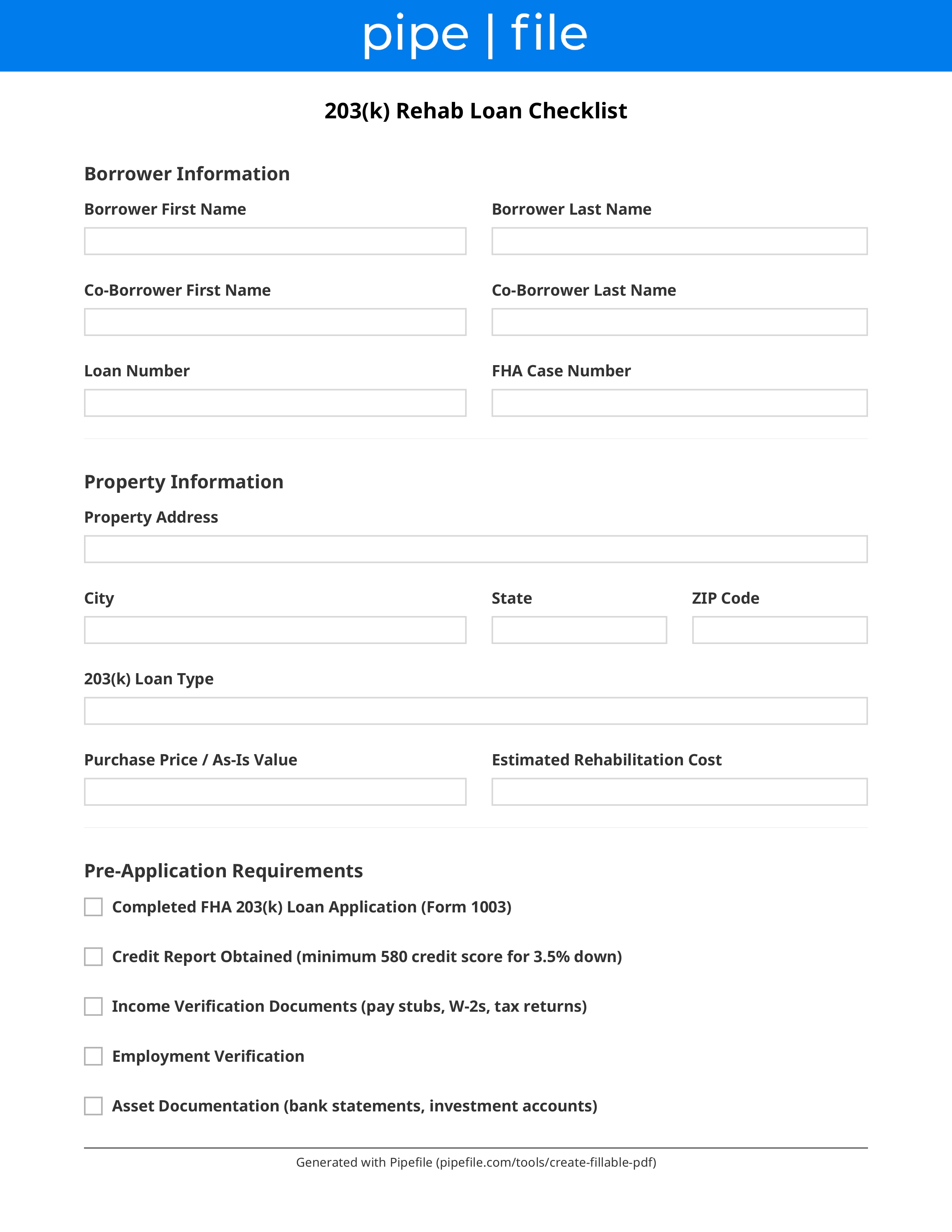
203(k) Rehab Loan Checklist: FHA Renovation Loan form template preview

Key Benefits

Separate Standard 203(k) vs. Limited 203(k) document paths
Collect consultant reports, bids, and a complete scope
Document contingency reserve and draw process
Pair FHA borrower docs with renovation exhibits
Reduce conditions on the renovation escrow
Professional FHA rehab lending workflow

Common Use Cases

Owner-occupants buying a fixer with FHA 203(k)Homeowners refinancing into a 203(k) to renovateFHA lenders packaging Standard or Limited 203(k)HUD consultants assembling the specification of repairsContractors bidding a 203(k) scope of workBuyers comparing 203(k) to a conventional renovation loan

Frequently Asked Questions

What is an FHA 203(k) loan?
FHA 203(k) lets an owner-occupant finance purchase (or refinance) plus renovation in one mortgage. Limited 203(k) covers smaller, non-structural repairs. Standard 203(k) handles structural work and requires a HUD consultant. Funds sit in escrow and are released in draws.
What extra documents does 203(k) require?
Beyond a normal FHA file: a specification of repairs, contractor bid(s), consultant report (Standard), homeowner-contractor agreement, contingency reserve, and an after-improved appraisal. Limited 203(k) may skip the consultant if the work is simple and under the repair cap.
Can investors use 203(k)?
No. 203(k) is for owner-occupants. Investors typically use hard-money or fix-and-flip products instead. Occupancy must be primary residence, and FHA identity-of-interest and flip rules still apply.
How do renovation draws work?
The lender holds rehab funds in escrow. After inspections (and consultant sign-off on Standard 203(k)), draws pay the contractor. A contingency reserve (often 10-20%) covers overruns. Unused funds can pay down the principal at the end.

Checklist

Application

FHA loan application and identity-of-interest certifications
Required

Owner-occupant only. All borrowers. Standard FHA case number process.

Borrower Documentation

FHA income, asset, and credit documentation
Required

Pay stubs, W-2s or returns, statements, and CAIVRS/credit as for any FHA loan.

Renovation

Specification of repairs or work write-up
Required

Line-item scope. Standard 203(k) uses the HUD consultant's report.

Contractor bid(s) and homeowner-contractor agreement
Required

Licensed contractor. Insurance and W-9 as the lender requires.

HUD 203(k) consultant report (Standard 203(k))

Required for Standard/structural. Limited 203(k) often waives the consultant.

Contingency reserve calculation (typically 10-20%)
Required

Held in escrow for overruns. Amount depends on age of home and consultant.

Valuation

After-improved appraisal (lender-ordered)
Required

Value after renovations supports the total mortgage. Plans must match the scope.

Property Documentation

Homeowners insurance that will cover the property during rehab
Required

Confirm vacancy or renovation endorsements if the home will be uninhabitable.

Identity

Government-issued photo ID for all borrowers
Required

Plus FHA required identification and Social Security verification.