Home/Templates/Finance/Lending/Conventional Loan Checklist: Document Requirements

Conventional Loan Checklist: Document Requirements

Mortgage and Lending Professional Resource

Streamline conventional loan applications with our comprehensive document checklist. For homebuyers, refinancers, loan officers, and mortgage professionals. Conventional loans (non-government, often conforming to Fannie Mae or Freddie Mac guidelines) require income verification, asset documentation, employment history, credit authorization, and identity and property documents. Ensure complete paperwork for purchase or refinance so you avoid conditions and speed up underwriting and closing.
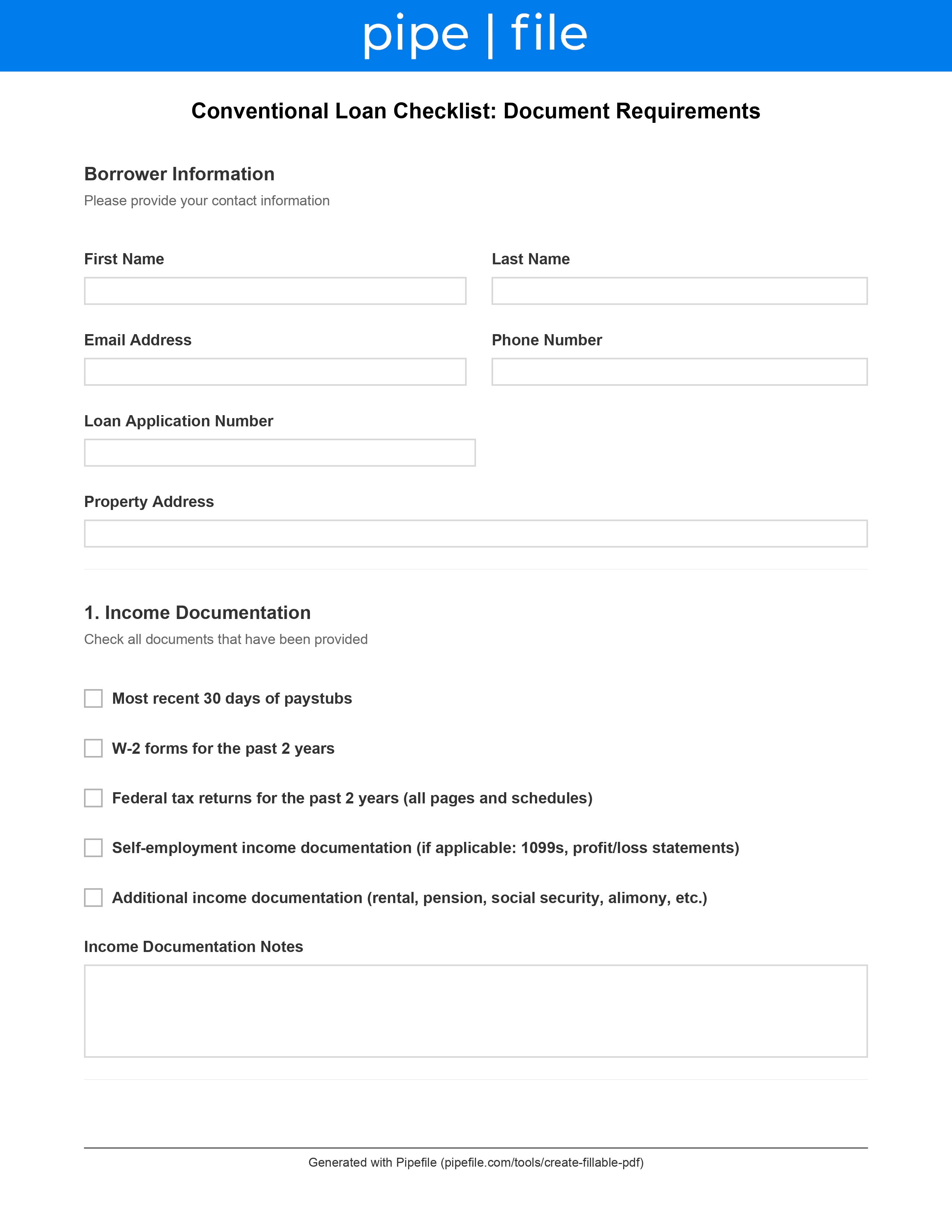
Conventional Loan Checklist: Document Requirements form template preview

Key Benefits

Meet conforming loan documentation standards
Gather income, assets, and employment docs in one place
Reduce underwriting conditions and delays
Support purchase and refinance applications
Organize paperwork for faster closing
Professional mortgage workflow

Common Use Cases

Homebuyers applying for conventional purchase loansBorrowers refinancing with a conventional mortgageLoan officers and mortgage brokers processing conforming loansUnderwriters verifying conventional loan filesReal estate agents preparing clients for financingLenders following Fannie Mae and Freddie Mac guidelines

Frequently Asked Questions

What is a conventional loan?
A conventional loan is a mortgage that is not insured or guaranteed by the federal government (unlike FHA, VA, or USDA). It may be conforming (within Fannie Mae/Freddie Mac loan limits and guidelines) or non-conforming (jumbo or portfolio). Documentation requirements are typically income, assets, employment, credit, and property-related.
What income documents are required for a conventional loan?
Typically you need recent pay stubs (often 30 days), W-2s for the last 2 years, and tax returns (2 years, with all schedules) if self-employed or with variable income. Lenders may also request employment verification and proof of additional income (bonus, overtime, rental, etc.).
How many months of bank statements do I need?
Most conventional programs require 1–2 months of statements for checking and savings; some require 2 months for all asset accounts. You may need to explain and document large deposits. Investment and retirement account statements are often needed for reserves and down payment source.
Do conventional loans have different documentation levels?
Yes. Lenders may offer full documentation, reduced documentation, or other programs. This checklist focuses on standard full-doc conventional requirements. Your loan officer can confirm what your specific product and investor require.

Checklist

Application

Complete loan application (1003 or lender equivalent)
Required

Signed and dated. All borrowers. Accurate income, assets, debts, and property information.

Credit report authorization (and any credit explanation if required)
Required

Signed authorization to pull credit. Written explanation for derogatory items if lender requests.

Income Documentation

Recent pay stubs (typically 30 days; lender may require 2 months)
Required

All employers for all borrowers. YTD and current pay. Overtime/bonus if used for qualifying.

W-2s for the last 2 years
Required

From all employers. Supports income history and consistency.

Federal tax returns (2 years, all schedules and attachments)
Required

Required for self-employed and often for W-2 borrowers. Signed. Include 1099s, K-1s if applicable.

Documentation for other income (rental, alimony, child support, etc.)

Only if used to qualify. Lease, divorce decree, court order, or other proof per lender guidelines.

Employment

Employment verification (verbal VOE or written, per lender)
Required

Confirm employer name, hire date, position, income. Some lenders use The Work Number or direct VOE.

Asset Documentation

Bank statements (1–2 months for checking, savings, and asset accounts)
Required

All pages. Document source of funds for down payment and reserves. Explain large deposits.

Investment and retirement account statements (if used for funds or reserves)

401(k), IRA, brokerage. Often 1–2 months. Document accessibility and any withdrawal for closing.

Gift letter and donor documentation (if using gift funds)

Signed gift letter (lender format), proof of donor’s ability to give, and transfer of funds.

Identity

Government-issued photo ID for all borrowers
Required

Driver’s license or passport. Current and legible.

Property

Property-related documents (purchase agreement, appraisal, insurance as required)
Required

Purchase: executed contract. Refinance: existing deed or mortgage statement. Appraisal and proof of insurance per lender timeline.