←Home/Templates/Finance/Lending/Fix and Flip Loan Checklist: Document Requirements

Fix and Flip Loan Checklist: Document Requirements

Real Estate Investor and Hard Money Lending Resource

Streamline your fix and flip loan application with our comprehensive document checklist. For real estate investors and hard-money or private lenders. Cover the purchase contract, rehab budget and scope, after-repair value (ARV) comps, builder or contractor bids, experience resume, liquidity, entity documents, and exit strategy so the lender can underwrite both the deal and the sponsor.
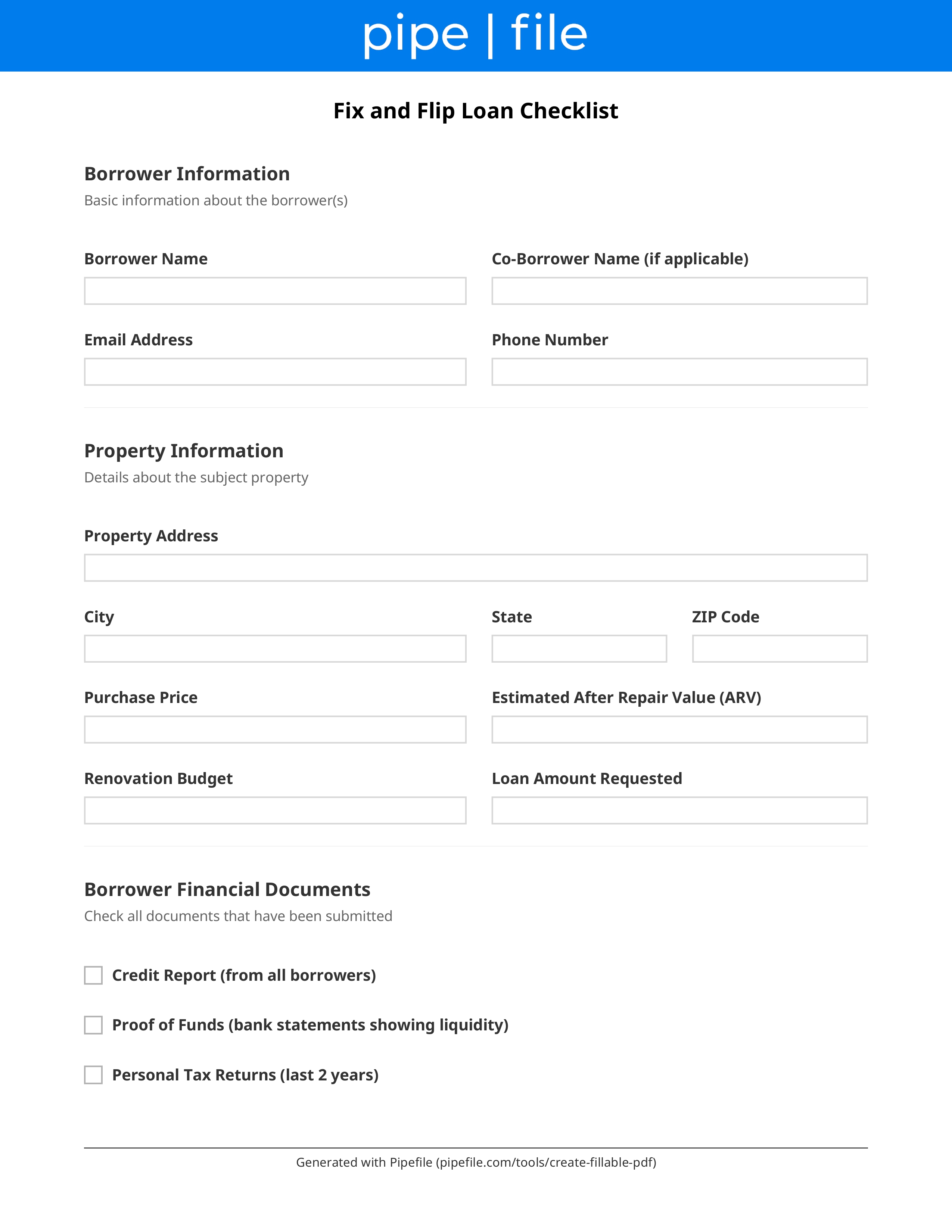
Fix and Flip Loan Checklist: Document Requirements form template preview

Key Benefits

Package purchase, rehab budget, and ARV in one file
Document contractor bids and project timeline
Show investor experience and liquidity
Spell out the sale or refinance exit
Reduce conditions on hard-money and private flip loans
Professional investor lending workflow

Common Use Cases

Investors financing a residential fix-and-flip purchaseHard-money lenders underwriting rehab and ARVBorrowers refinancing a cash purchase into a flip loanContractors acting as owner-builders on a flipPartnerships documenting experience and liquidityBrokers packaging private-money investor loans

Frequently Asked Questions

What is a fix and flip loan?
A fix and flip loan is short-term financing to buy and renovate a property, then sell (or refinance) it. Lenders size the loan off purchase price plus rehab, capped by a percentage of after-repair value. Interest is often interest-only. The exit is usually a retail sale.
What documents do flip lenders require?
Typical items are the purchase contract, rehab scope and budget, contractor bids, ARV comps or a BPO, proof of liquidity for down payment and overrun reserves, entity documents, a track record or resume, credit authorization, and a written exit strategy with a timeline.
How do lenders calculate the loan amount?
Most programs lend a percentage of purchase plus a percentage of rehab, not to exceed a max LTV of ARV (for example 70% ARV). Experience, credit, and liquidity affect the advance rate. A detailed budget and credible comps support a higher leverage request.
Do first-time flippers get approved?
Some lenders accept first-time investors at lower leverage with more liquidity and a licensed contractor. Others require completed projects. Document any related construction or project-management experience and be ready for a larger down payment.

Checklist

Application

Fix and flip loan application
Required

Borrower/entity, property address, purchase price, rehab budget, and requested loan.

Transaction

Executed purchase contract and any addenda
Required

Price, dates, inspection rights, and assignment if applicable.

Project

Line-item rehab budget and scope of work
Required

Materials, labor, permits, contingency. Matches contractor bids.

Contractor bids or owner-builder resume and licenses
Required

Supports budget credibility. Include licenses and insurance if required.

Valuation

After-repair value comps or appraisal/BPO
Required

Recent sold comps that match the finished product. Lender may order a BPO.

Asset Documentation

Proof of funds for down payment, closing costs, and overrun reserves
Required

Bank or brokerage statements, all pages. Seasoning per lender.

Sponsor

Investor resume or track record of completed projects

Addresses, dates, and outcomes. First-timers document related experience.

Business Documentation

Entity documents if borrowing in an LLC or corp

Articles, operating agreement, EIN, and authorization to borrow.

Underwriting

Written exit strategy and target timeline
Required

Retail sale vs. refinance. Backup plan if the market slows.