←Home/Templates/Legal/Family Law/Parenting Plan Checklist: Custody Agreement Requirements

Parenting Plan Checklist: Custody Agreement Requirements

Family Law Attorney and Client Resource

Build a complete parenting plan with a document and clause checklist for custody agreements. Cover legal custody (decision-making), the regular parenting-time calendar, holidays and vacations, exchanges and travel, communication rules, school and medical decision-making, relocation notice, and child-support cross-references so the plan can be filed or incorporated into a decree. For attorneys, mediators, and parents preparing a stipulated plan. This is not legal advice; required parenting-plan elements and best-interest factors differ by state—confirm current local rules and forms before filing.
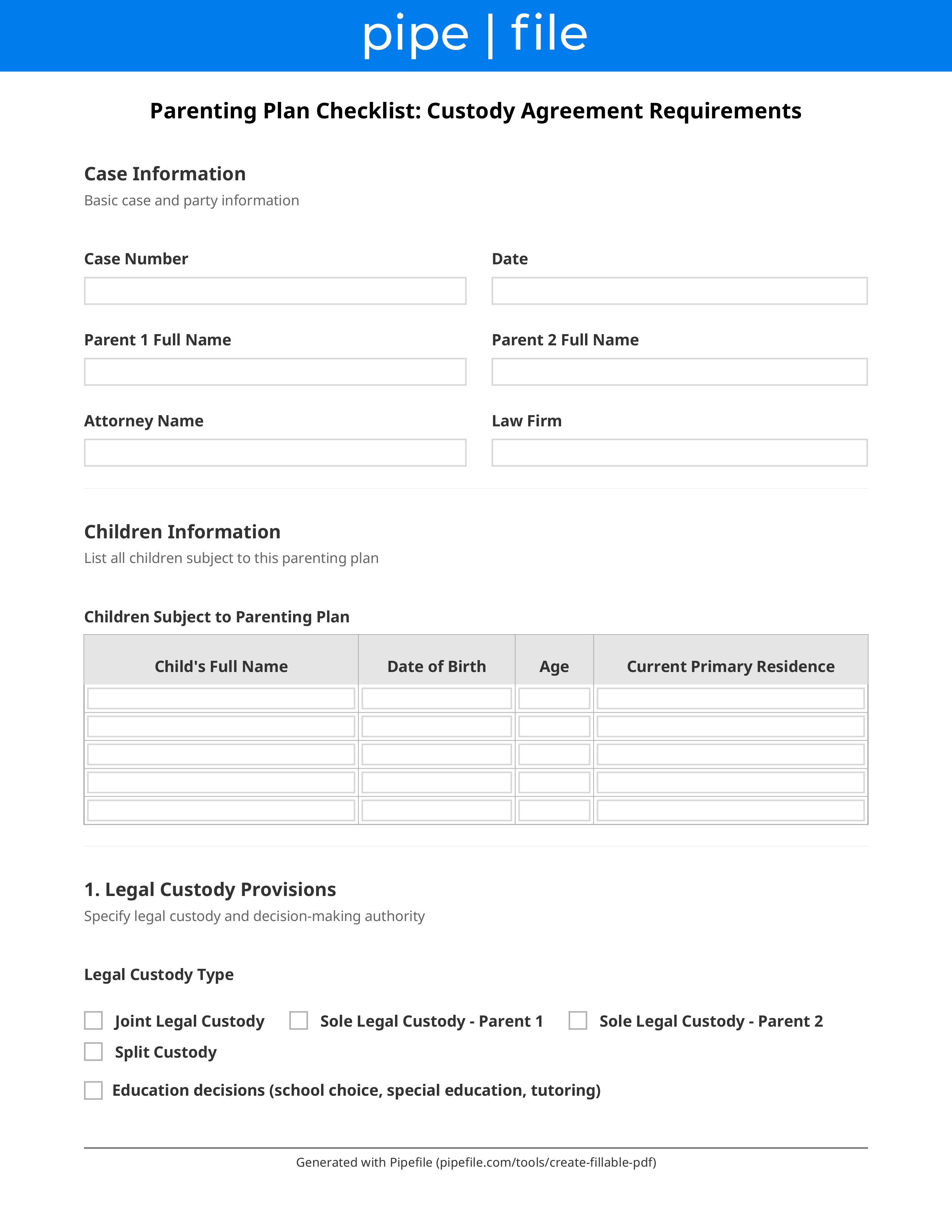
Parenting Plan Checklist: Custody Agreement Requirements form template preview

Key Benefits

List the decision-making and parenting-time terms courts expect
Cover holidays, vacations, and school-break calendars
Document exchange locations and travel notice rules
Address school, medical, and extracurricular decisions
Include relocation and dispute-resolution provisions
Reduce gaps that send parties back to court

Common Use Cases

Attorneys drafting stipulated parenting plans for a decreeMediators structuring custody and parenting-time agreementsParents preparing a proposed plan before a hearingParalegals checking a draft plan against local required clausesModification cases replacing an outdated scheduleLegal aid clinics helping clients complete court parenting-plan forms

Frequently Asked Questions

What is the difference between legal and physical custody in a plan?
Legal custody is decision-making (school, medical, religion). Physical custody or parenting time is where the child lives and the calendar of overnights. Plans should state both, including whether decisions are joint or allocated to one parent for specific topics.
Which calendar details prevent later disputes?
Weekday and weekend overnights, holiday rotation (including the start and end hour), summer or school-break weeks, and what happens when holidays overlap a regular weekend. Name the exchange location and who provides transportation.
Should child support appear in the parenting plan?
Many plans cross-reference a separate support order or worksheet rather than restating the full calculation. If your court form combines them, attach the guideline worksheet. Keep support figures consistent with the overnight count in the plan.
Is a parenting-plan checklist legally binding?
No. The checklist is a drafting aid. A plan becomes enforceable when signed and entered as a court order or incorporated into a decree under your state's rules. Counsel should review the draft against current local forms.

Checklist

Custody Terms

Legal custody and decision-making allocation (joint or sole; any reserved topics)
Required

Specify school, medical, mental health, and religious decisions. Note how deadlocks are resolved.

Parenting Time

Regular parenting-time calendar with overnight counts and exchange days
Required

Weekday and weekend pattern. State start and end times. Note whose address is the child's primary residence if the court requires it.

Holiday, birthday, and school-break schedule with start and end times
Required

Cover at least major federal holidays, winter and spring break, and the child's birthday. State which schedule controls when they overlap.

Exchanges

Exchange locations, transportation responsibility, and out-of-area travel notice
Required

Include airport or long-distance travel notice periods and passport consent if relevant.

Communication

Parent-to-parent and parent-to-child communication methods and frequency
Required

Phone, video, or app. Any restrictions should be written narrowly and tied to safety if applicable.

Decision-Making

School enrollment, medical providers, and how records are shared
Required

Who may attend appointments, how insurance cards are exchanged, and emergency-treatment authority.

Relocation

Relocation notice period and any geographic restriction the parties agree to
Required

Many states require a statutory notice before a move. Confirm the local statute rather than inventing a shorter period.

Enforcement

Mediation or other dispute-resolution step before a new motion, if the court allows it

Do not require mediation in cases involving a protective order unless counsel has confirmed it is permitted.