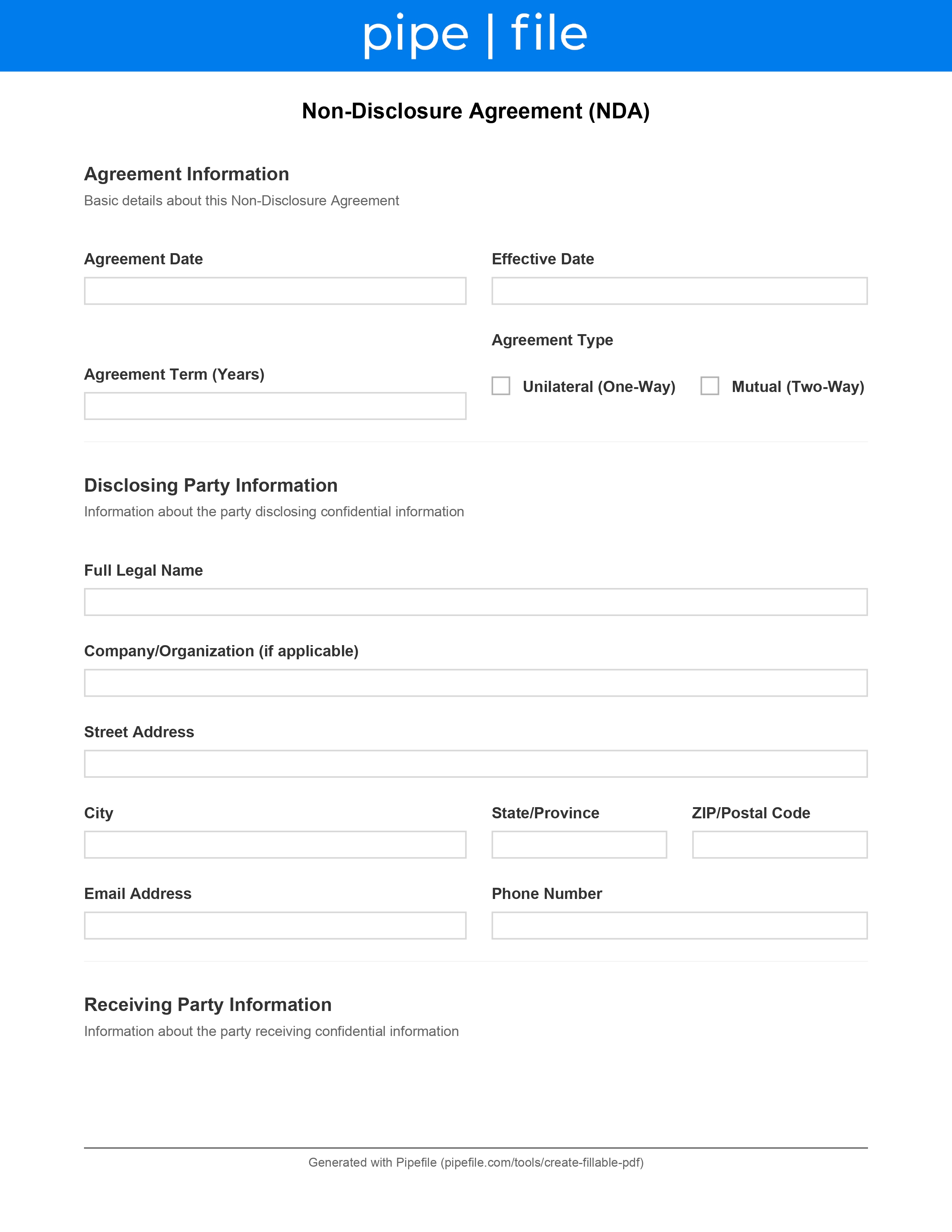
Non-Disclosure Agreement (NDA) Template
Business and Legal Professional Resource
Streamline NDA drafting with our non-disclosure agreement template and checklist. For businesses, attorneys, and professionals protecting confidential information. Whether mutual or one-way, ensure your NDA clearly defines the parties, what counts as confidential information, the purpose and permitted use, exclusions, term and duration, return or destruction of materials, and governing law so you protect trade secrets, business plans, and other sensitive data. Use this checklist to draft or review NDAs before sharing proprietary information with employees, contractors, partners, or potential acquirers.
Key Benefits
Common Use Cases
Frequently Asked Questions
What is the difference between a mutual and a one-way NDA?
What should be excluded from confidential information?
How long should an NDA last?
Are NDAs enforceable?
Checklist
Parties
Full legal names and addresses. If mutual, state that each party may be discloser or recipient as applicable.
Scope
Describe categories: technical data, business plans, financials, customer lists, etc. May include oral or written information marked or identified as confidential, or all information disclosed in connection with the purpose.
e.g. 'evaluation of a potential business relationship.' Recipient may use information only for that purpose and not for competitive use or to benefit third parties.
Standard carve-outs so information that is not truly confidential is not covered. Reduces disputes and supports enforceability.
Obligations
Hold in confidence, use only for permitted purpose, restrict access to those with need to know, and not disclose to third parties without prior written consent unless required by law (with notice).
If recipient is required by law to disclose, give discloser prompt notice so they may seek a protective order. Recipient may disclose only what is legally required.
Term
e.g. 2–5 years from disclosure or from termination of the business relationship. State that obligations survive for the survival period (or indefinitely for trade secrets if desired).
Recipient returns or destroys all materials (and certifies destruction if requested). Some NDAs allow retention of copies for legal/compliance; specify if applicable.
Legal Protection
NDA does not grant any license or ownership. All confidential information remains the property of the discloser.
Which state's law governs and where disputes are resolved. Consider arbitration for speed and confidentiality.
Acknowledge that breach may cause irreparable harm and that injunctive relief is appropriate. Specify whether damages are also available.
Execution
Duly authorized signatories, titles, and date. Consider whether to allow electronic signatures.