Home/Templates/Legal/Family Law/Marital Asset & Debt Checklist: Divorce Financial Disclosure

Marital Asset & Debt Checklist: Divorce Financial Disclosure

Family Law Attorney and Divorce Financial Disclosure Resource

Streamline divorce financial disclosure with our marital asset and debt checklist. For family law attorneys, paralegals, and divorcing spouses. Ensure complete identification of real property, vehicles, bank and investment accounts, retirement and pension assets, business interests, personal property, and all marital debts so you meet court disclosure requirements, support equitable distribution, and avoid sanctions or reopened proceedings. Use this checklist alongside your jurisdiction's financial affidavit or schedule of assets and debts.
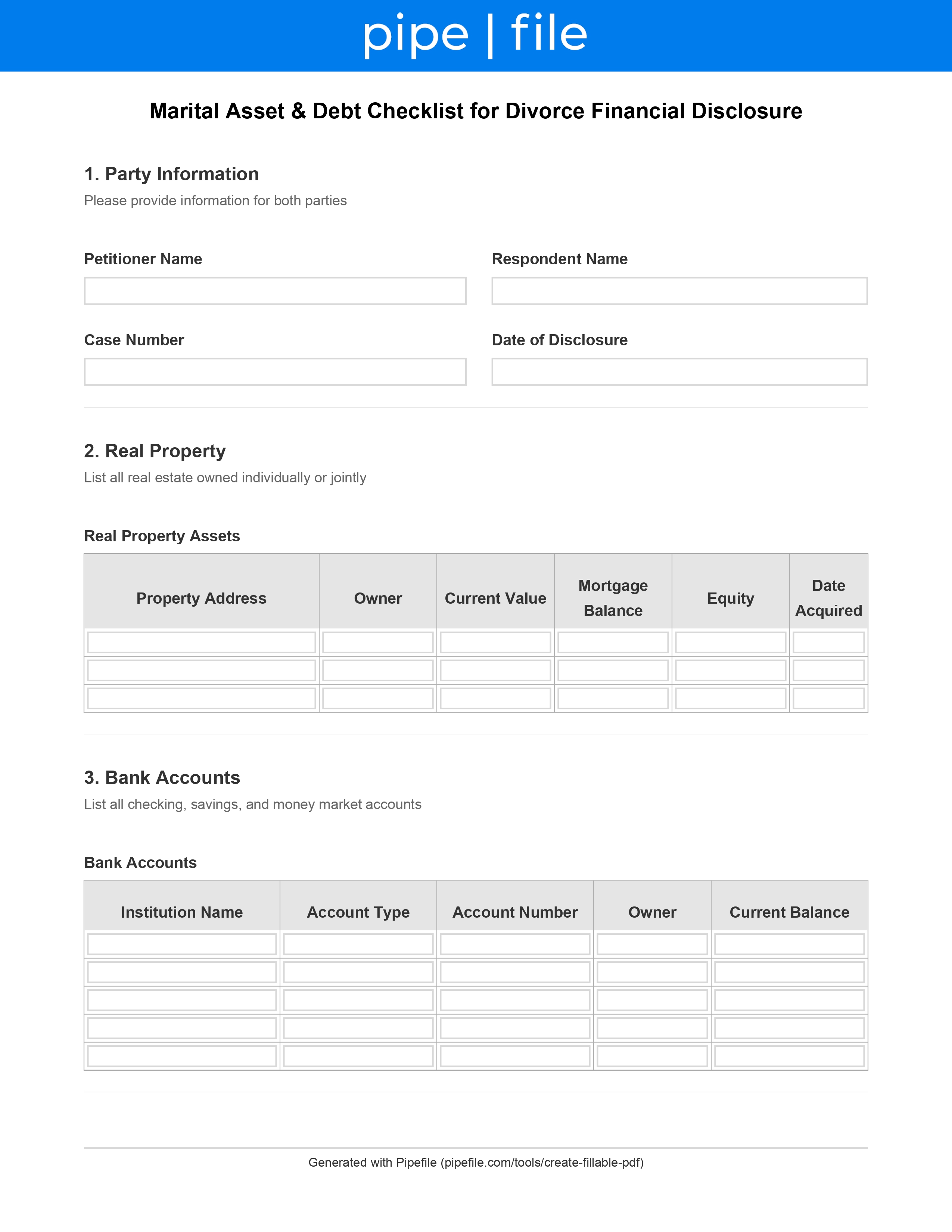
Marital Asset & Debt Checklist: Divorce Financial Disclosure form template preview

Key Benefits

Identify all marital assets and debts in one place
Meet court and statutory disclosure requirements
Support equitable distribution and settlement negotiations
Reduce risk of incomplete disclosure and sanctions
Organize real property, accounts, retirement, and debt
Professional divorce financial disclosure workflow

Common Use Cases

Preparing court-required financial affidavits or schedulesCompleting mandatory disclosure in divorce or dissolutionSupporting mediation or settlement negotiationsAttorney-led asset and debt discovery and organizationClient self-disclosure with attorney reviewPost-divorce compliance and amendment of disclosures

Frequently Asked Questions

What counts as a marital asset or debt?
Generally, assets and debts acquired during the marriage are marital, subject to jurisdiction-specific rules. Separate property (e.g. premarital, inherited, or excluded by agreement) may be non-marital. When in doubt, disclose and let the court or agreement determine classification. Full disclosure protects you and meets ethical obligations.
Why must I list all accounts and debts even if I think they are separate?
Courts and rules typically require full disclosure of all assets and debts so the other party and the court can assess what is marital vs separate. Failing to disclose can lead to sanctions, reopened cases, or unfavorable rulings. Your attorney can help you classify and value items after disclosure.
How do I value assets and debts for the checklist?
Use current balances or values (e.g. statement date, appraisal, payoff amount). For real estate, use a recent appraisal or tax assessment; for retirement, use the most recent statement. Your attorney or a financial expert can help with valuation standards in your jurisdiction.
Is this checklist a substitute for my jurisdiction's financial affidavit?
No. This checklist helps you identify and organize what to disclose. You still must complete your state or court's required financial affidavit, schedule of assets and debts, or other forms. Use this list to ensure nothing is missed when filling out those forms.

Checklist

Assets

Real property: primary residence, vacation property, rental property, land (address, deed, current value, mortgage balance)
Required

List each parcel. Include equity (value minus mortgage). Note title holder and date acquired. Attach deeds and recent statements.

Bank accounts: checking, savings, money market (institution, account type, balance, account holder)
Required

Include joint and individual accounts. Use statement date for balance. Note if any account was opened pre-marriage or with separate funds.

Retirement and pension accounts: 401(k), 403(b), IRA, pension, TSP, etc. (plan name, balance, vested value, account holder)
Required

Use most recent statement. Note marital portion if account predates marriage. Some plans require a QDRO for division.

Brokerage and investment accounts: stocks, bonds, mutual funds, ETFs (account name, current value, account holder)
Required

Include taxable and non-retirement accounts. Use statement or portfolio value as of a consistent date.

Vehicles: cars, boats, RVs, motorcycles (make, model, year, title holder, value, loan balance if any)
Required

Use Kelley Blue Book or similar for value. Include any outstanding auto or boat loans in the debt section.

Business interests: ownership in LLC, corporation, partnership, sole proprietorship (entity name, % owned, estimated value or basis)
Required

Disclose even if value is uncertain. Valuation may require a business appraiser. Include professional practices.

Significant personal property: jewelry, art, collections, furniture, electronics (description, estimated value)
Required

List items above a threshold your attorney recommends (e.g. $500–$1,000). Appraisals may be needed for high-value items.

Other assets: crypto, royalties, intellectual property, annuities, life insurance cash value, trusts, inheritances received during marriage
Required

Disclose all material assets. Note source and timing for possible separate-property arguments; full disclosure is still required.

Debts

Mortgage debt: primary residence, second home, rental property (lender, balance, monthly payment, account holder)
Required

Use current payoff or statement balance. Note which property secures the debt.

Consumer debt: credit cards, personal loans, lines of credit (creditor, balance, monthly payment, account holder)
Required

Include joint and individual cards and loans. Use most recent statement balance.

Vehicle and other secured loans: auto loans, boat loans, HELOCs (lender, balance, collateral, account holder)
Required

Match to vehicles or property listed in assets. Include HELOCs even if secured by real property already listed.

Other debts: tax debt, student loans, medical debt, business debt, loans from family (creditor, balance, account holder)
Required

Disclose all known debt. If uncertain, list and note 'amount to be confirmed.'