←Home/Templates/Legal/Immigration/I-601 Checklist: Inadmissibility Waiver Document Requirements

I-601 Checklist: Inadmissibility Waiver Document Requirements

Immigration Attorney and Waiver Resource

Build an inadmissibility waiver with our Form I-601 checklist. Form I-601 (Application for Waiver of Grounds of Inadmissibility) asks USCIS to waive certain grounds—commonly unlawful presence, fraud or misrepresentation, some criminal grounds, and health-related grounds—when the statute allows and the applicant shows the required hardship or other standard. This checklist helps immigration attorneys gather evidence of extreme hardship to a qualifying relative (typically a U.S. citizen or LPR spouse or parent), plus civil documents, medical and financial records, and country-conditions evidence. Form I-601A is a different provisional unlawful-presence waiver; do not use this checklist as if they were the same form. Confirm current instructions. Not legal advice.
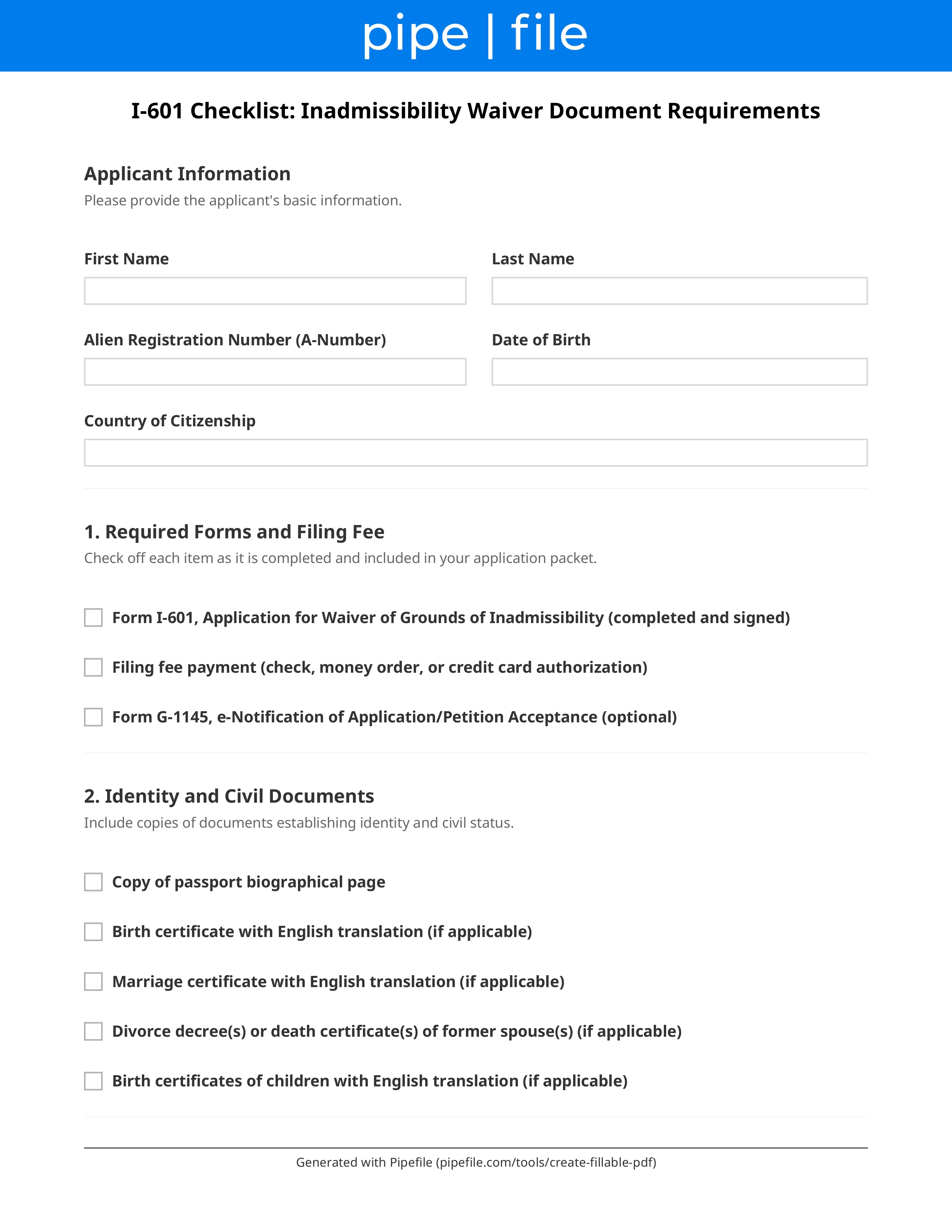
I-601 Checklist: Inadmissibility Waiver Document Requirements form template preview

Key Benefits

Match the waiver ground to the correct form (I-601 vs I-601A)
Identify the qualifying relative for extreme hardship
Organize medical, financial, and country-conditions evidence
Reduce RFEs on hardship and relationship proof
Coordinate with consular processing or adjustment
Professional waiver workflow

Common Use Cases

Unlawful-presence waivers in consular immigrant visa casesFraud or misrepresentation waivers when a qualifying relative existsCertain criminal-ground waivers with rehabilitation evidenceHealth-related waivers with civil-surgeon or specialist recordsImmigration attorneys preparing hardship packetsParalegals assembling qualifying-relative civil documents

Frequently Asked Questions

How is I-601 different from I-601A?
I-601A is the provisional unlawful-presence waiver, generally filed in the United States before immigrant visa processing abroad, and is limited to unlawful presence. I-601 is the broader waiver used for several grounds and is often filed after a consular finding of inadmissibility. Using the wrong form wastes months.
Who is a qualifying relative for extreme hardship?
For many I-601 grounds, the qualifying relative is a U.S. citizen or LPR spouse or parent. Children are not qualifying relatives for some common grounds even though hardship to a child can support the spouse or parent's hardship. The statute for the specific ground controls.
What is extreme hardship?
It is hardship to the qualifying relative that is greater than the common consequences of family separation or relocation. Evidence often includes medical care needs, financial dependence, country conditions, educational disruption, and family ties. USCIS weighs the totality of the circumstances.
Can I file I-601 with I-212?
Yes, when both consent to reapply after removal (I-212) and a separate waiver ground (I-601) apply. They address different problems. Map every INA 212(a) ground before choosing forms.

Checklist

USCIS Forms

Complete Form I-601 (Application for Waiver of Grounds of Inadmissibility)
Required

Name each ground to be waived. Do not file I-601A unless the case is a provisional unlawful-presence waiver.

Form I-212 package if consent to reapply after removal is also required

Removal cases often need both I-212 and I-601. See the I-212 checklist.

Immigration History

Consular or USCIS document stating the inadmissibility ground(s)
Required

Refusal worksheet, I-601A-related notices do not replace an I-601 finding. Attach the actual ground cited.

Identity Documents

Proof of status and relationship of the qualifying relative
Required

U.S. passport, birth certificate, or green card, plus marriage or birth certificates proving the relationship.

Supporting Documents

Detailed hardship declarations from the qualifying relative and applicant
Required

Explain medical, financial, educational, and country-specific hardship with facts, not slogans.

Medical records if health is part of the hardship claim

Letters from treating physicians, treatment plans, and evidence that care is unavailable abroad if alleged.

Country-conditions evidence if relocation hardship is claimed

Reliable reports on security, medical care, employment, and other conditions tied to this family.

Financial Requirements

Financial records showing dependence, income, and assets

Tax returns, pay stubs, mortgage, and evidence the qualifying relative cannot relocate or live apart.

Filing fee payment (check current fee on USCIS.gov)
Required

Confirm filing location (USCIS lockbox vs. consular packet) from the current instructions.

Documentation

Certified English translations for foreign-language documents

Civil documents from abroad almost always need translations.