Family Law Mediation Checklist
For Family Law Attorneys and Legal Professionals
This checklist is designed for family law attorneys and legal professionals preparing for mediation sessions. It provides a comprehensive, industry-standard inventory of documents required to ensure a successful mediation process involving divorce, child custody, or spousal support. Each item includes specific requirements, quality indicators, and timeline considerations to demonstrate expertise and help you serve your clients with confidence.
Key Benefits
Common Use Cases
Frequently Asked Questions
Why is a comprehensive document checklist important for family law mediation?
Are notarized copies required for all documents?
What if one party cannot provide a requested document?
Checklist
Personal Documents
Must be a government-issued, certified copy. Photocopies are not accepted. Required to verify marital status and date of marriage.
Required for all children under 18 years. Must be official government-issued documents. Needed to establish parentage in custody discussions.
Legal Forms
If a separation agreement exists, provide the complete signed and dated original or notarized copy. Essential for referencing agreed-upon terms prior to mediation.
Attach certified copies of any court-issued orders. Critical for determining current support obligations and compliance.
If available, provide a detailed draft including visitation schedules, decision-making authority, and dispute resolution methods. Shows preparation and willingness to negotiate.
Financial Documents
Must be completed using court-approved form, signed and notarized within the last 60 days. Disclose all assets, debts, income, and expenses. Cross-reference with supporting documents such as tax returns and bank statements.
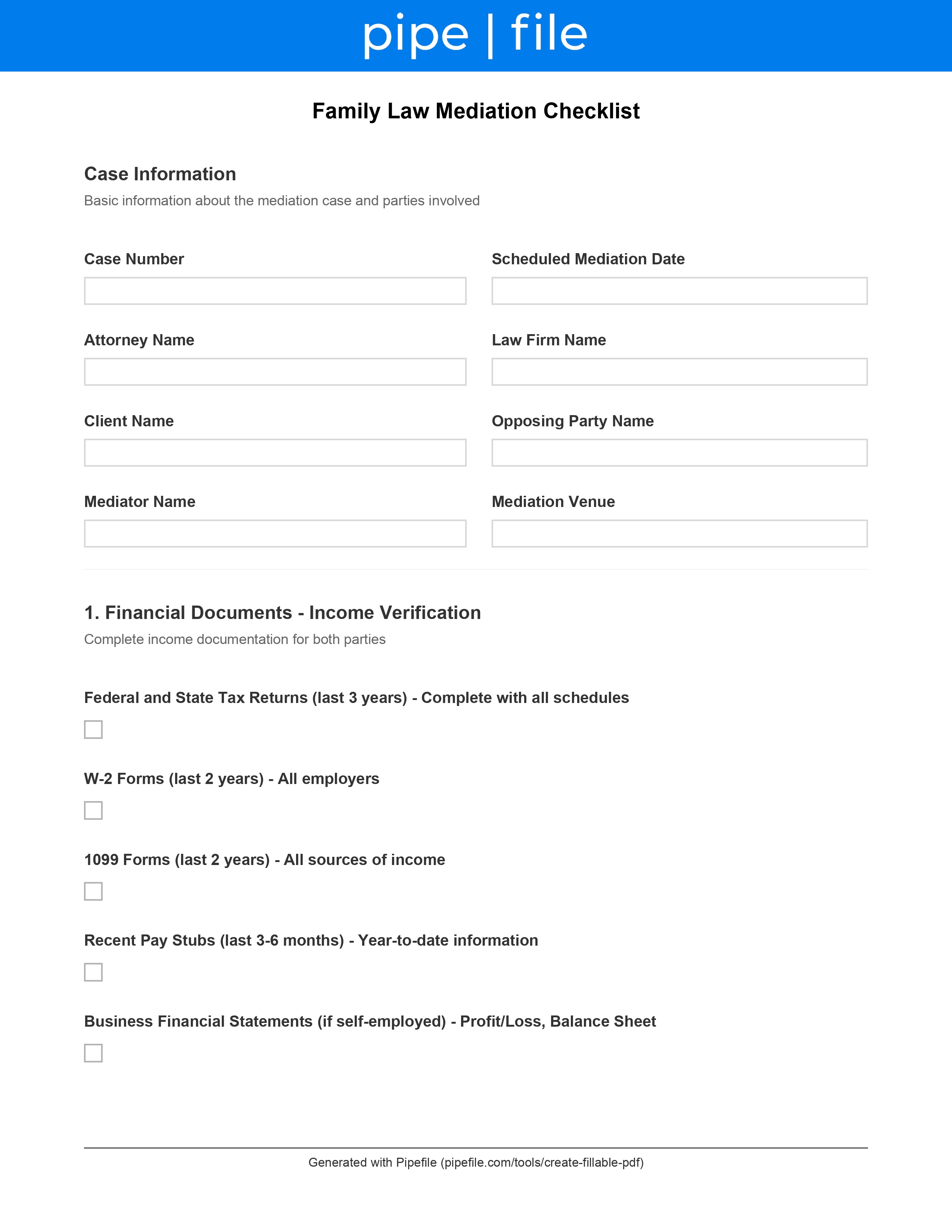
Include signed copies of federal and state returns. Attach all schedules and W-2/1099 forms. Required for accurate assessment of income and assets.
Provide consecutive pay stubs for the past 90 days. If self-employed, supply profit and loss statements for the same period. Demonstrates current income and earning capacity.
Include checking, savings, and joint accounts. Statements must be official, unaltered PDFs or originals. Required for identifying marital assets and financial transactions.
Include 401(k), IRA, pension, and brokerage statements. Must show account holder name, balances, and recent transactions. Important for equitable distribution proceedings.
List all outstanding debts, including credit cards, loans, and lines of credit. Provide account statements or payoff letters. Required for equitable debt division.
Supporting Evidence
Provide copies of deeds, mortgage statements, and property tax assessments. Needed to establish ownership, equity, and liabilities in property division.
Include coverage details, premiums, and dependents covered. Required to address ongoing insurance needs post-mediation.
Appraisals must be conducted by licensed professionals within the last 12 months. Include for high-value assets such as homes, vehicles, or collections. Supports fair asset division.