Home/Templates/Insurance/Certificate of Insurance (COI) Request Form

Certificate of Insurance (COI) Request Form

Business and Risk Management Resource

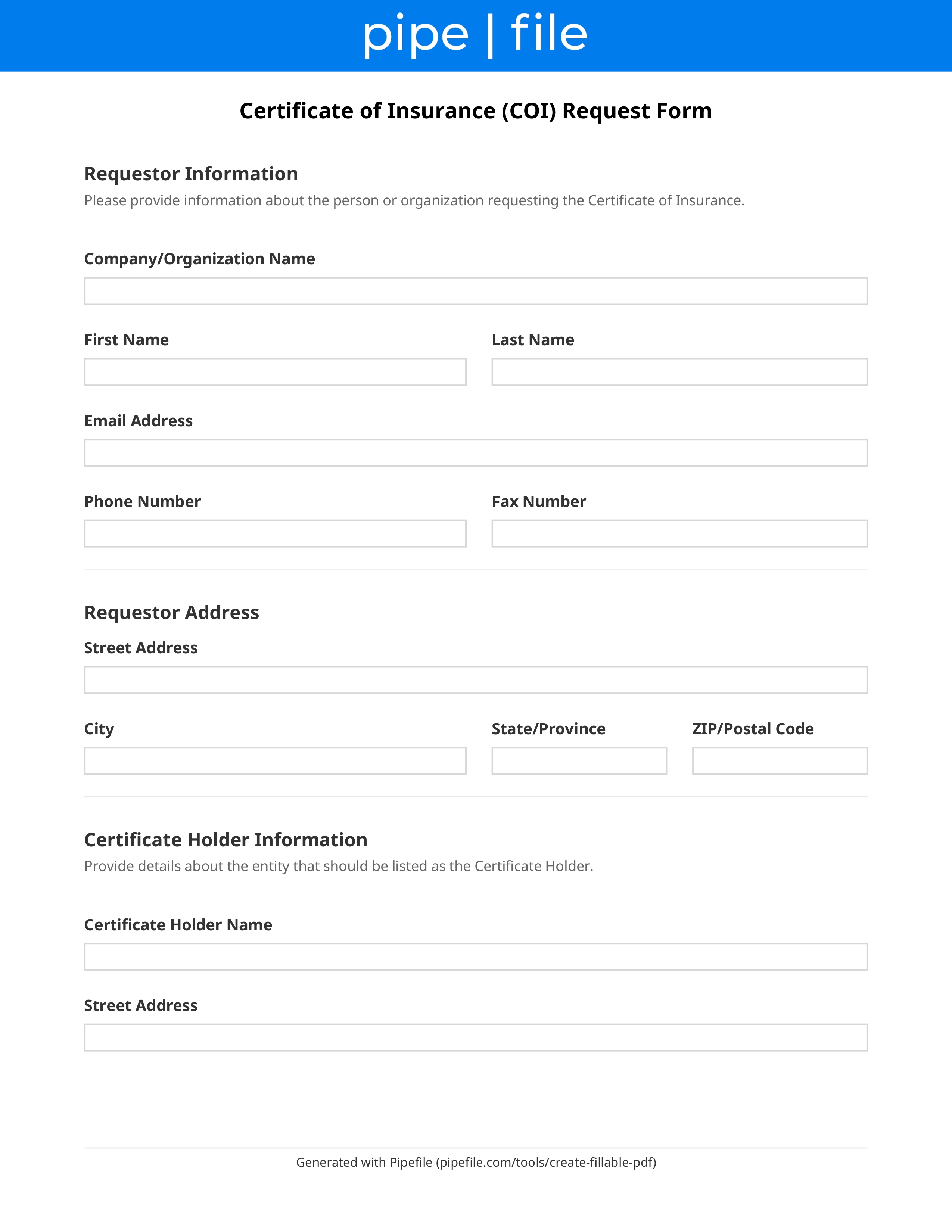
Request certificates of insurance (COI) correctly with our COI request form and checklist. For businesses, risk managers, and contract administrators. When you hire vendors, contractors, or partners, you often need proof of their insurance. This checklist covers who is requesting and from whom, which coverages to require (general liability, auto, workers comp, umbrella, professional/E&O), minimum limits, additional insured and certificate holder wording, waiver of subrogation, and how and when to receive the COI. Use it to standardize COI requests and reduce risk from underinsured or uninsured parties.
Key Benefits

Standardize what you require from vendors and contractors
Specify coverage types, limits, and additional insured status
Request waiver of subrogation when needed
Set a clear deadline and submission method
Reduce risk from underinsured or missing COIs
Professional vendor and contract management

Common Use Cases

Companies requesting COIs from vendors before contract signingProperty managers requiring COIs from contractors and tenantsEvent and venue managers collecting COIs from vendorsGeneral contractors collecting COIs from subcontractorsRisk and procurement teams standardizing COI requirementsCompliance with contract or lease insurance requirements

Frequently Asked Questions

What is a certificate of insurance (COI)?
A certificate of insurance is a one- or two-page document issued by an insurer or agent that summarizes a policyholder's insurance coverage (e.g. general liability, auto, workers comp). It shows policy types, limits, effective and expiration dates, and often lists the certificate holder and additional insureds. It is evidence of insurance but is not the policy itself; contract requirements should be backed by actual policy terms.
Why request a COI from vendors or contractors?
You request a COI to verify that the other party has insurance in place before they perform work or provide services. If they cause injury or property damage, their insurance may respond first. Requiring minimum limits and additional insured status helps protect your organization. Many contracts and leases explicitly require the vendor or tenant to provide a COI.
What is additional insured status?
When you are named as an additional insured on another party's policy, that policy may cover you for claims arising out of their work or operations. The certificate often shows 'Additional Insured' and your entity as certificate holder. The actual policy or endorsement must grant additional insured status; the COI is evidence. Specify that you must be added as additional insured on the relevant policies (e.g. general liability).
How often should I collect updated COIs?
Policies renew annually (or at other intervals). Request a new COI at contract start and whenever the policy renews, or at least annually. Some organizations require COIs before each project or event. Set a deadline (e.g. 10 days before work begins) and follow up if the COI is not received; do not allow work without current evidence of coverage.

Checklist

Parties

Identify requester (your company, contact, email) and vendor/contractor (company name, contact)
Required

Your company is the certificate holder and the party requiring proof. The vendor or contractor is the insured who must provide the COI. Include project or contract reference if applicable.

Coverage Requirements

General liability: require minimum limits (e.g. $1M per occurrence / $2M aggregate)
Required

Commercial general liability (CGL) covers third-party bodily injury and property damage. Specify minimum limits; common is $1M/$2M or higher. Confirm coverage applies to the work or services being performed.

Auto liability: require if vendor will use vehicles (e.g. $1M combined single limit)

Required when the vendor or their employees will drive on your behalf or on your premises. Specify minimum limits. Owned, non-owned, and hired auto may be relevant.

Workers compensation: require if required by state or contract

Many states require workers comp for employers. If the vendor has employees and will work on your site or under your contract, require proof of workers comp (and employers liability). This helps protect you from claims by their employees.

Umbrella/excess or professional (E&O) liability: require if relevant to scope

Umbrella or excess liability provides higher limits. Professional liability (E&O) applies to professional services (e.g. consultants, architects). Require when the scope of work or contract warrants it.

Certificate Holder

Require additional insured status for your entity on general liability (and auto if applicable)
Required

Specify that your company (and any related entities) must be named as additional insured on the CGL policy (and auto if required). The COI should show 'Certificate Holder' and 'Additional Insured' with your exact legal name and address. Policy endorsement may be required; confirm with your risk team.

Policy Terms

Waiver of subrogation: require if required by contract or risk preference

A waiver of subrogation prevents the insurer from seeking recovery from you for amounts it paid. Many contracts require the other party to obtain this endorsement. State it on the request form so the vendor asks their insurer for it.

Verification

COI must show current effective and expiration dates (cover project or contract period)
Required

Ensure the policy is in force for the duration of the work or contract. If the project spans a renewal date, request an updated COI after renewal. Do not accept expired or future-dated-only certificates for current work.

Process

Set deadline for COI submission (e.g. before work starts or contract signing)
Required

Give the vendor a clear deadline (e.g. 10 business days before start date). State that work cannot begin without an acceptable COI on file. Follow up if not received.

Specify how to submit (email, portal, mail) and where to send
Required

Provide the email address or portal link for COI submission. Accept PDF from insurer or agent. Retain COIs in a central file or system for audit and claims.