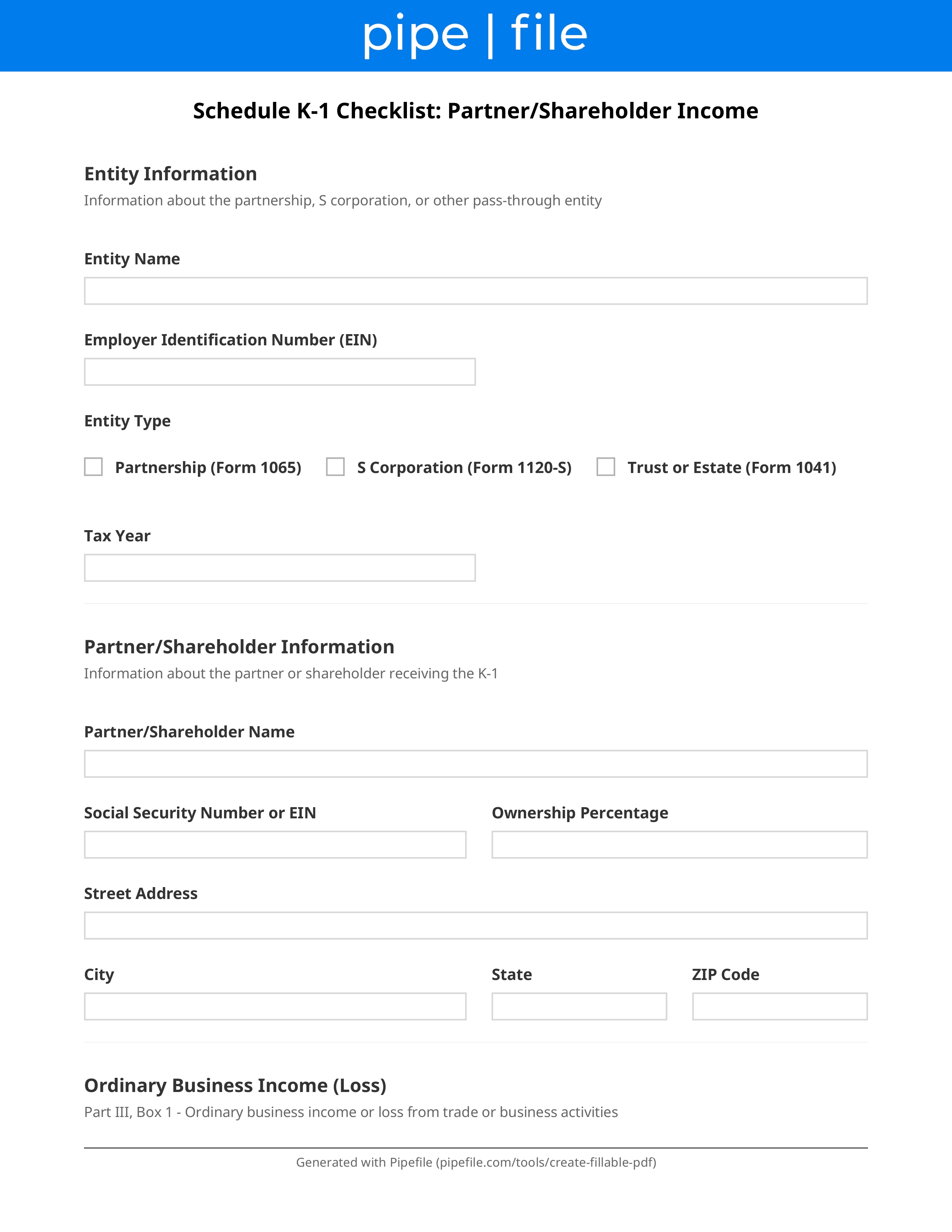
Schedule K-1 Checklist: Partner/Shareholder Income
CPA and Pass-Through Owner Resource
Handle Schedule K-1 income with our partner and shareholder checklist. For CPAs, partners, S-corp shareholders, and pass-through entity managers. Gather ownership data, basis schedules, capital accounts, guaranteed payments, and the K-1 itself so amounts flow correctly to Forms 1040, 1065, or 1120-S. Confirm current K-1 boxes and state requirements. Not tax advice.
Key Benefits
Track ownership and allocation percentages
Maintain basis before claiming losses
Review K-1 boxes before filing Form 1040
Document capital account changes
Capture state K-1 and composite filings
Professional pass-through tax workflow
Common Use Cases
Partners receiving Form 1065 K-1sS-corp shareholders receiving Form 1120-S K-1sCPAs reviewing client K-1 packagesFund and LLC investors organizing K-1sOwners tracking debt basis and at-risk amountsTax preparers waiting on late K-1s
Frequently Asked Questions
What is a Schedule K-1?
A Schedule K-1 reports a partner’s or shareholder’s share of income, deductions, credits, and other items from a pass-through entity. Partnership K-1s come from Form 1065; S corporation K-1s come from Form 1120-S.
Why does basis matter?
You generally cannot deduct losses or receive tax-free distributions beyond your basis. Keep annual stock/debt (S corp) or outside basis (partnership) schedules even if the K-1 looks complete.
When should I expect my K-1?
Pass-through entities often issue K-1s in March or later. Many individuals extend Form 1040 while waiting. Ask the entity for an estimated K-1 if you need to project payments.
Do state K-1s differ?
Yes. States may require separate K-1 equivalents, withholding, or composite returns. Keep federal and state K-1 packages together.
Checklist
K-1 Package
Final Schedule K-1 (Form 1065 or 1120-S) for the tax year
Required
Use the final issued K-1, not a draft, for e-file.
K-1 statements and footnotes (credits, 199A, foreign, etc.)
Required
Many items live only in the statements—not the face of the K-1.
Ownership
Ownership / profit / loss percentages for the year
Required
Confirm mid-year changes match the K-1 footnotes.
Basis
Updated basis schedule (stock/debt or outside basis)
Required
Start from prior year and apply current K-1 activity.
Capital
Capital account beginning/ending balances (partnerships)
Compare to K-1 Item L when present.
Distributions
Cash and property distribution records
Required
Needed for basis and gain recognition analysis.
Debt
Shareholder / partner loan activity during the year
Affects debt basis and at-risk amounts.
State
State K-1s / composite / withholding certificates
Retain for multi-state filing.