←Home/Templates/Legal/Immigration/I-730 Checklist: Refugee/Asylee Relative Petition

I-730 Checklist: Refugee/Asylee Relative Petition

Immigration Attorney and Humanitarian Resource

Petition for a spouse or child with our Form I-730 checklist. Form I-730 (Refugee/Asylee Relative Petition) lets a principal refugee or asylee request follow-to-join or accompanying benefits for a spouse and unmarried children under 21 who qualify as derivatives. There is no filing fee. Petitions generally must be filed within two years of the refugee admission or asylum grant, with limited exceptions. This checklist helps immigration attorneys, legal aid, and asylees gather proof of the principal's status, civil documents proving the relationship, and identity evidence for each beneficiary. Confirm current USCIS and Department of State processing. Not legal advice.
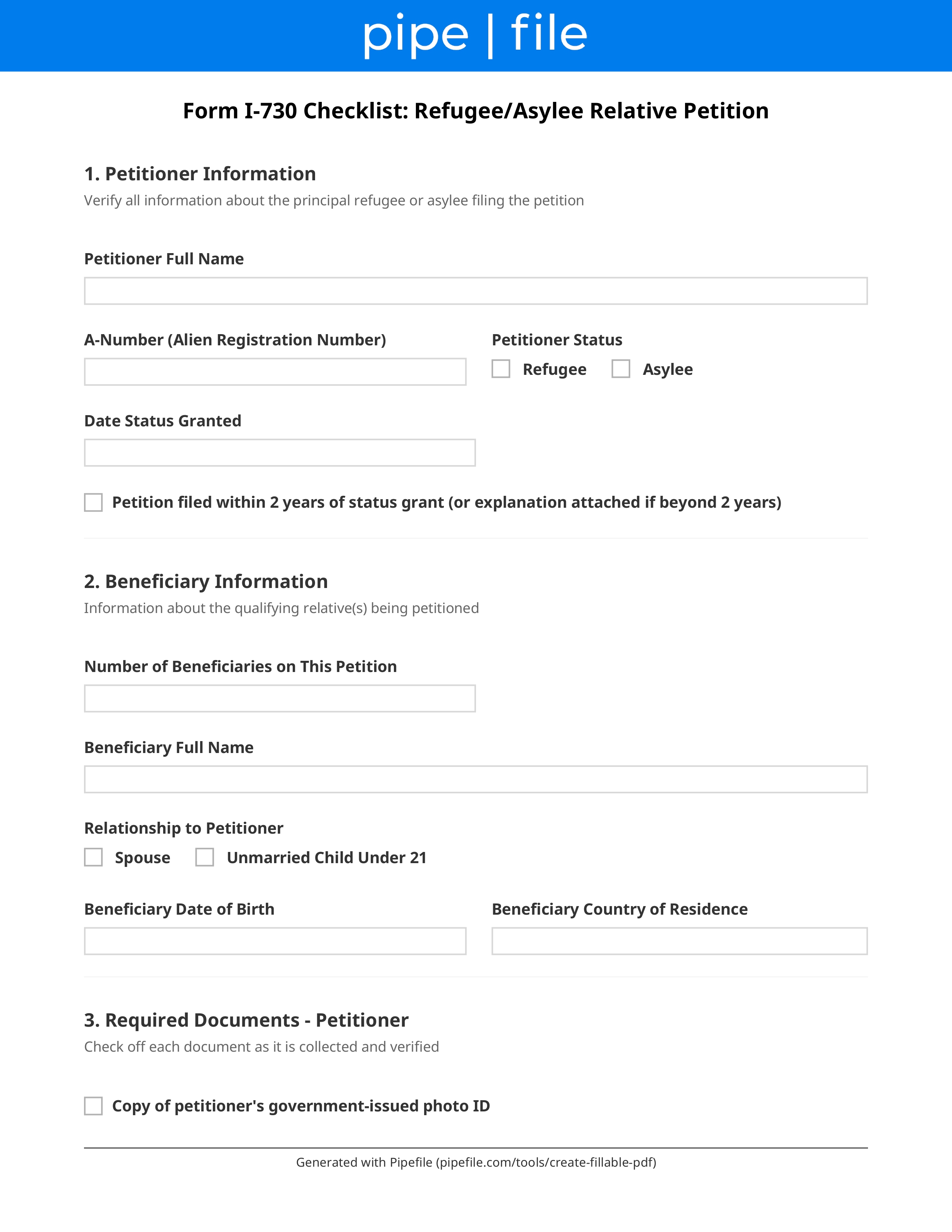
I-730 Checklist: Refugee/Asylee Relative Petition form template preview

Key Benefits

File within two years of refugee admission or asylum grant
Document the qualifying relationship for each beneficiary
There is no I-730 filing fee
Prepare civil documents and translations early
Coordinate overseas interview vs. USCIS processing
Professional humanitarian family-reunification workflow

Common Use Cases

Asylees petitioning for a spouse still abroadRefugees requesting follow-to-join for unmarried children under 21Immigration attorneys filing I-730 after an I-589 grantLegal aid and nonprofits assembling relationship evidenceParalegals collecting birth and marriage certificatesFamilies with mixed overseas and in-U.S. beneficiaries

Frequently Asked Questions

Who can file Form I-730?
A principal refugee or asylee (or in some cases a person who adjusted on that basis, per current instructions) may petition for a spouse and for unmarried children under 21 who qualified as derivatives. The relationship generally must have existed at the time of the principal's admission as a refugee or grant of asylum.
Is there a deadline to file I-730?
Yes. USCIS generally requires filing within two years of the refugee admission or asylum grant. Limited exceptions exist (for example certain humanitarian reasons). Do not wait—civil documents from the home country can take months.
Is there a filing fee for I-730?
No. There is no fee to file Form I-730. Beneficiaries may still need photos, medical exams, or travel documents later in processing. Check current instructions for biometrics and interview locations.
How does I-730 relate to I-589?
I-589 is the principal's asylum application. Eligible spouse and children can be included on I-589 if they are in the United States. I-730 is the follow-to-join petition, often used when the relative is abroad or was not included on the I-589.

Checklist

USCIS Forms

Complete Form I-730 (Refugee/Asylee Relative Petition) for each beneficiary as required
Required

Use the current edition. File a separate petition when the instructions require one per beneficiary.

Identity Documents

Proof the petitioner is a refugee or asylee (I-94, approval notice, or green card as applicable)
Required

Must show the date of refugee admission or asylum grant—the two-year clock usually starts there.

Petitioner's identity document (passport, EAD, or other government ID)
Required

Name must match the asylum or refugee record. Include name-change documents if any.

Photographs of each beneficiary per form instructions
Required

Follow current I-730 photo specifications. Overseas processing may also need visa photos later.

Beneficiary identity document (passport or national ID) if available

Passports speed overseas processing. Explain unavailability if the beneficiary cannot obtain one yet.

Civil Documents

Marriage certificate for a spouse beneficiary

Required for spouse petitions. Include evidence the marriage existed at the required time under the instructions.

Birth certificate for each child beneficiary

Must show the parent-child relationship. Secondary evidence if a birth certificate cannot be obtained.

Documentation

Certified English translations for foreign-language civil documents

Birth and marriage records from the home country almost always need translations.

USCIS Process

Confirm filing is within two years of the grant or admission, or document an exception
Required

Late filings need the exception evidence described in the current instructions.