←Home/Templates/Legal/Immigration/I-600 Checklist: Orphan Petition Requirements

I-600 Checklist: Orphan Petition Requirements

Immigration Attorney and Intercountry Adoption Resource

Prepare an orphan petition with our Form I-600 checklist. Form I-600 (Petition to Classify Orphan as an Immediate Relative) is used to classify a child from a country that is not a Hague Adoption Convention country as an immediate relative of a U.S. citizen. Many families file Form I-600A (Application for Advance Processing) first so USCIS can approve the prospective parent(s) before identifying a child. This checklist helps immigration attorneys and adoptive families gather the home study, proof of U.S. citizenship, evidence the child meets the orphan definition, and adoption or intent-to-adopt documents. Hague Convention cases use I-800/I-800A instead. Confirm current USCIS and country-of-origin rules. Not legal advice.
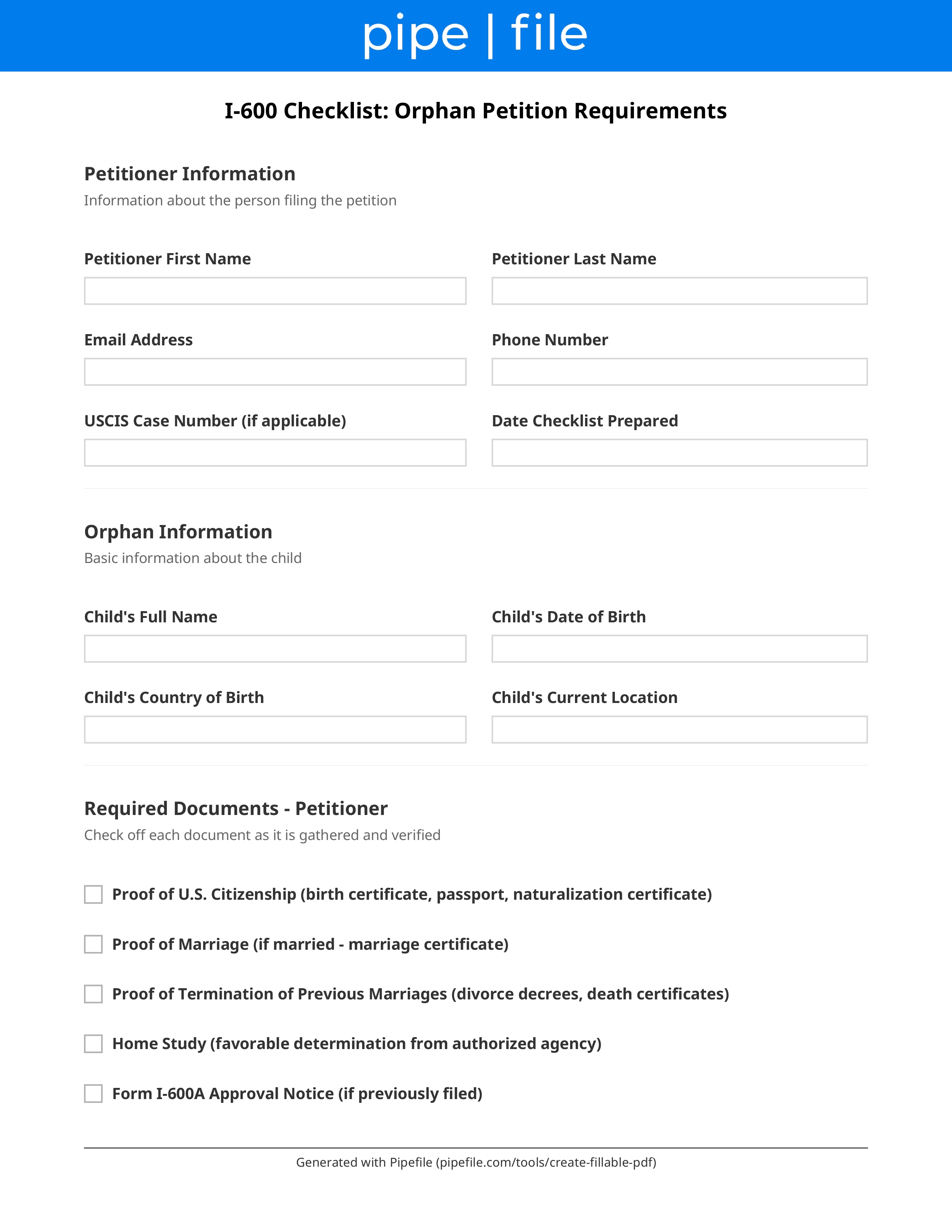
I-600 Checklist: Orphan Petition Requirements form template preview

Key Benefits

Distinguish I-600 (non-Hague) from I-800 (Hague)
File I-600A advance processing when it fits the case
Gather home study and citizenship evidence early
Document that the child meets the orphan definition
Reduce RFEs on civil documents and translations
Professional intercountry adoption workflow

Common Use Cases

U.S. citizens adopting from a non-Hague countryFamilies filing I-600A before a child is identifiedImmigration attorneys preparing orphan petitionsAdoption agencies assembling home-study packagesParalegals collecting birth, abandonment, or death recordsProspective parents preparing for the visa interview abroad

Frequently Asked Questions

When do I use I-600 instead of I-800?
Use I-600 when the child's country of origin is not a Hague Adoption Convention country (or when USCIS instructions say the non-Hague process applies). Hague Convention countries generally require I-800A and I-800. Filing the wrong form can delay or bar the case.
Should I file I-600A first?
I-600A lets USCIS determine that the prospective parent(s) are suitable before a specific child is identified. Many families file I-600A, complete the home study, then file I-600 once a child is identified. You can file I-600 with a child already identified if the instructions allow.
What is a home study for I-600?
A home study is a suitability assessment prepared by a licensed provider that covers the prospective parent(s), household, finances, and ability to care for the child. USCIS has specific content requirements. An outdated or incomplete home study is a frequent RFE.
What evidence shows a child is an orphan?
Evidence depends on the facts: death of both parents, disappearance, abandonment, or desertion as defined in the regulations, or a sole/surviving parent who is incapable of providing and has in writing irrevocably released the child. Country civil records and court orders must match that definition.

Checklist

USCIS Forms

Complete Form I-600 (Petition to Classify Orphan as an Immediate Relative)
Required

Use the current edition. Confirm the country is processed under the non-Hague orphan process.

Form I-600A advance processing approval or concurrent filing if applicable

File I-600A first when a child is not yet identified. Attach the I-600A approval notice to I-600 when required.

Identity Documents

Proof the petitioner is a U.S. citizen
Required

U.S. passport, birth certificate, naturalization certificate, or certificate of citizenship.

Photographs of the child as required by the form instructions
Required

Follow current photo specifications in the I-600 instructions.

Supporting Documents

Home study meeting USCIS content requirements
Required

Must be recent enough under the instructions. Include any state-required addenda and the provider's license.

Final adoption decree or evidence of intent to adopt plus legal custody
Required

Whether adoption is completed abroad or in the U.S. after admission depends on the country and the case.

Civil Documents

Evidence the child meets the regulatory orphan definition
Required

Death certificates, court findings of abandonment, or sole-parent release as applicable to the facts.

Child's birth certificate or secondary identity evidence
Required

If a birth certificate does not exist, use the secondary evidence allowed for that country.

Documentation

Certified English translations for foreign-language documents

Civil records from the country of origin almost always require translations.

Financial Requirements

Filing fee payment (check current fee and biometrics on USCIS.gov)
Required

I-600A and I-600 have separate fee rules. Confirm before filing.