Form W-4 Guide: Employee Tax Withholding Checklist
HR and Payroll Resource
Get new hires' federal tax withholding right with our Form W-4 guide and checklist. For HR, payroll, and employers in the U.S. Form W-4 (Employee's Withholding Certificate) determines how much federal income tax to withhold from pay. This checklist covers when to collect the W-4 (before first paycheck), Step 1 (name, SSN, filing status, multiple jobs), Step 2 (multiple jobs or spouse works), Step 3 (tax credits), Step 4 (other income, deductions, extra withholding), Step 5 (signature), and state withholding forms where applicable. Use it so payroll is accurate and employees avoid under- or over-withholding.
Key Benefits
Common Use Cases
Frequently Asked Questions
What is Form W-4?
When must the employee submit Form W-4?
What if the employee has multiple jobs or a working spouse?
Do we need a state withholding form too?
Checklist
Timing
Collect signed W-4 prior to the first payroll run. If not received, withhold using default (single, no adjustments). Remind new hires during onboarding. Allow updates anytime; implement per your payroll schedule.
Step 1
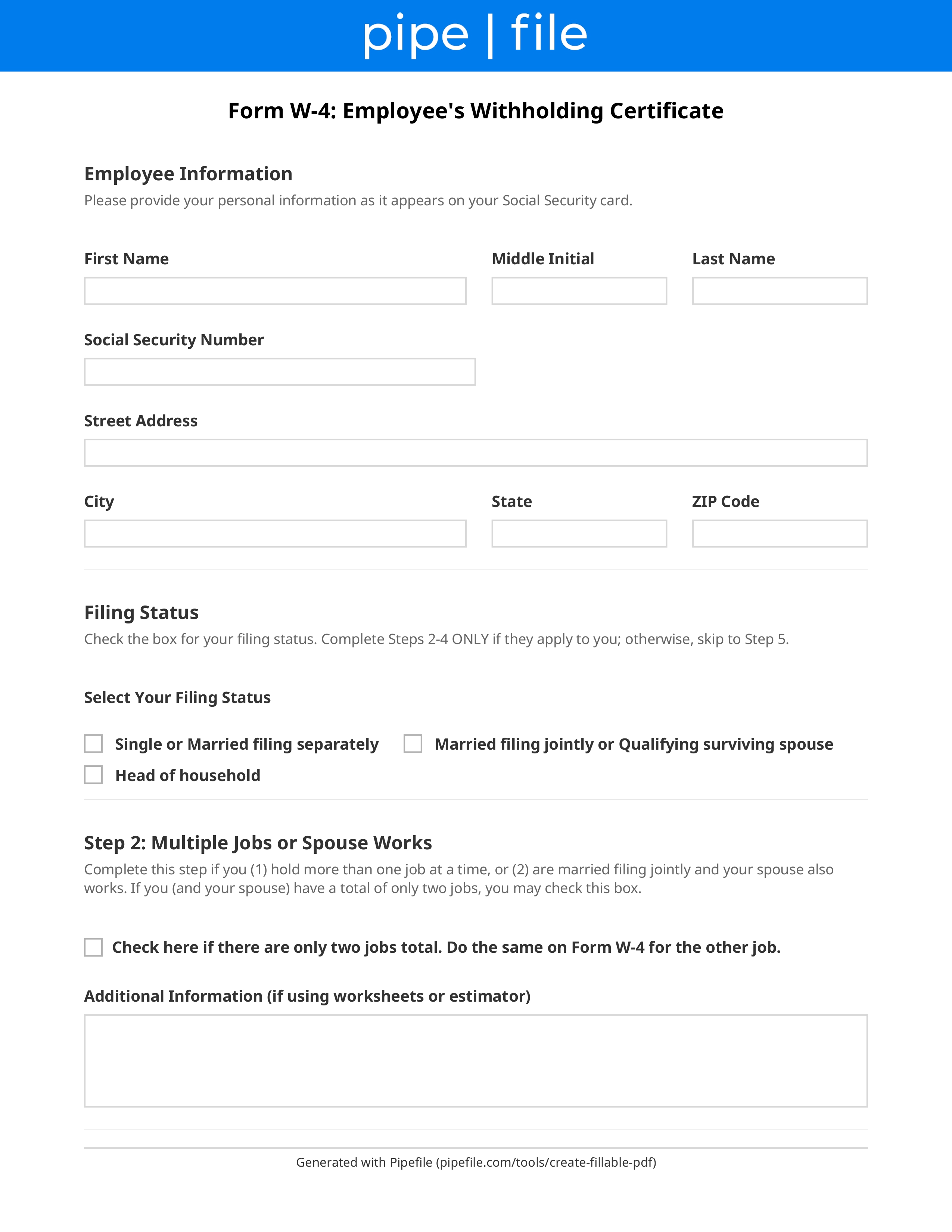
Legal name and SSN must match SSA records. Filing status choices: Single or Married filing separately; Married filing jointly or Qualifying surviving spouse; Head of household. Employee checks one. Correct SSN avoids IRS mismatch notices.
If the employee (or spouse) has more than one job, they check the box and complete Step 2 so withholding accounts for combined income. Otherwise withholding may be too low and they may owe at tax time.
Step 2
Employee uses the worksheet on the W-4 or the IRS Tax Withholding Estimator to figure extra withholding. Result may be an amount in Step 4(c). Do not advise on tax outcomes; provide the form and point to IRS resources.
Step 3
Employee enters dollar amounts for qualifying children and other dependents, and other credits. This reduces withholding. Only complete if they qualify; they may need to refer to IRS instructions or a tax preparer.
Step 4
4(a): Other income not from this job (e.g. interest, side job). 4(b): Deductions (itemized, student loan interest, etc.). 4(c): Extra amount to withhold per pay period. Optional; employee fills only if applicable.
Signature
Employee must sign and date the W-4. Electronic signature is acceptable if your system meets IRS e-sign requirements. Unsigned form is invalid; do not process until signed.
Compliance
IRS redesigned the W-4 in 2020. Use the latest version from IRS.gov. Old versions (e.g. pre-2020) may still be used by employees who had them on file before 2020, but new hires should use the current form.
State
If the employee works in a state with income tax and that state has its own withholding form, collect and retain it with the W-4. State forms vary; check state revenue department for current requirements.
Retention
Keep the W-4 as part of payroll records. IRS generally requires keeping employment tax records for at least 4 years. Store securely; provide to IRS if requested.